
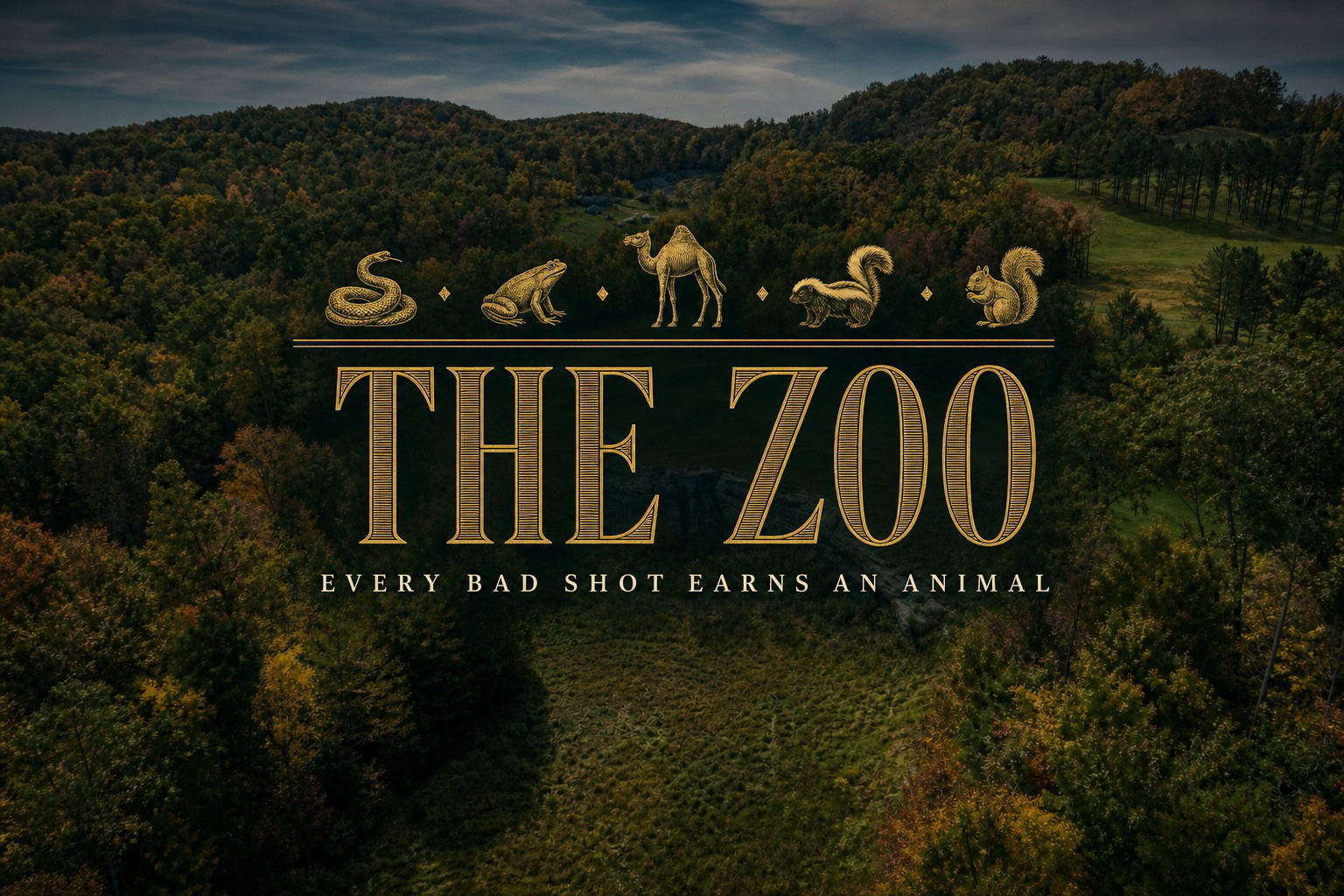
The Zoo takes the one-penalty side game most groups already play and runs five or six of them at once. Every common mistake gets an animal. Water is the frog, a bunker is the camel, three putts is the snake.
You hold an animal until another player makes the same mistake, and whoever still has animals when the round ends pays for them.
It runs alongside whatever you’re already playing, it doesn’t care what you shoot, and it takes about thirty seconds to explain on the first tee.

The Animals and What Earns Them
No two published lists agree on the names, and that’s fine. What matters is that each animal is tied to one specific mistake, and everybody knows which one before you start. A workable core five:
- Snake — Three-putt
- Frog — Ball in the water
- Camel — Ball in a bunker
- Skunk — Out of bounds
- Squirrel — Hitting a tree
From there groups add whatever their own round keeps producing. The gorilla for a lost ball, the anaconda for a four-putt, the jackass for missing a birdie putt from inside the flagstick, the ostrich for a whiff.
Most groups know the snake already. It’s the same three-putt hot potato as the standalone Snake golf game, and the Zoo just gives it company. It’s also the animal you can do the most about, since lag putting is mostly speed control and a few tweaks will stop most three-putts.
Because most of the list is trouble you find off the tee and around the green, it doubles as a record of where your round is leaking. If you finish holding the camel and the squirrel most weeks, our practice games and drills have a short-game and driving section aimed at exactly that.

How an Animal Changes Hands
Only one player can hold each animal at a time. Hit it in the water and the frog is yours. It stays yours until somebody else finds water, and then it’s theirs.
One stroke earns one animal. If a shot manages to break two rules at once, you take whichever the group agrees on and the other stays where it is.
There’s one way out. Hole a shot from off the green, a chip, a pitch, or a bunker shot, and you send one animal of your choice to the vet. Pick whichever you’re unlikely to nab again.
WHO ACTUALLY PAYS
Being bad early costs nothing. Three-putt on the opening green and the snake will have moved on long before you wrap up your round. It’s the mistakes you make late that kill you.
Water, out of bounds, and a lost ball all carry a stroke penalty on top of the animal, so the drop procedure matters. Our golf penalties guide has the relief options for red and yellow stakes side by side.

How Many Animals to Run
An animal only works if it moves. That one fact decides whether the game is any fun.
A three-putt happens several times a round in a foursome, so the snake changes hands all afternoon and nobody is stuck with it. A whiff happens once a season. Hand out an ostrich and it isn’t a hot potato at all, it’s a new best friend, and the player who earned it is paying for it eighteen holes later.
The same goes for the four-putt, the double hit, and the ball played from the wrong fairway. They’re funny once, but rarely pass along to the next person.
So keep the list to mistakes your group actually repeats. Five animals that move beat twelve that don’t, and every exotic one you add turns a bit more of the game into a tax on whoever is having the worst day.
That’s also the fairness catch. The Zoo ignores handicapping completely, so the higher handicapper collects more animals and holds them longer. If your group has a wide spread, cap the damage at three or four animals per player, or let anyone over the cap release one at the turn.

Settling Up at the End
Count what’s in each zoo on the last green. Everything settles at once.
Playing it for money
Set a dollar value per animal before you start. Five dollars is the usual figure, and you pay that to every other player for every animal you’re holding.
That multiplies faster than people expect. You’re paying three opponents, so three animals at 5 dollars each costs you forty-five dollars in a foursome. Groups that set it at more than five dollars an animal find that out the hard way.
Playing it for drinks
The count works the same way, the currency changes. A couple swigs every time an animal is captured or changes hands is the sensible setting, and the player finishing with the biggest zoo buys the first round afterward.
Keep it to swigs rather than shots and settle it in the clubhouse instead of on the course. If drinking beer and golfing is your thing, check our our collection of golf drinking games. And remember, never drink and drive.
Pick your five animals and go. Enjoy the round.