Nobody wants to be the Snake. That’s the whole point.
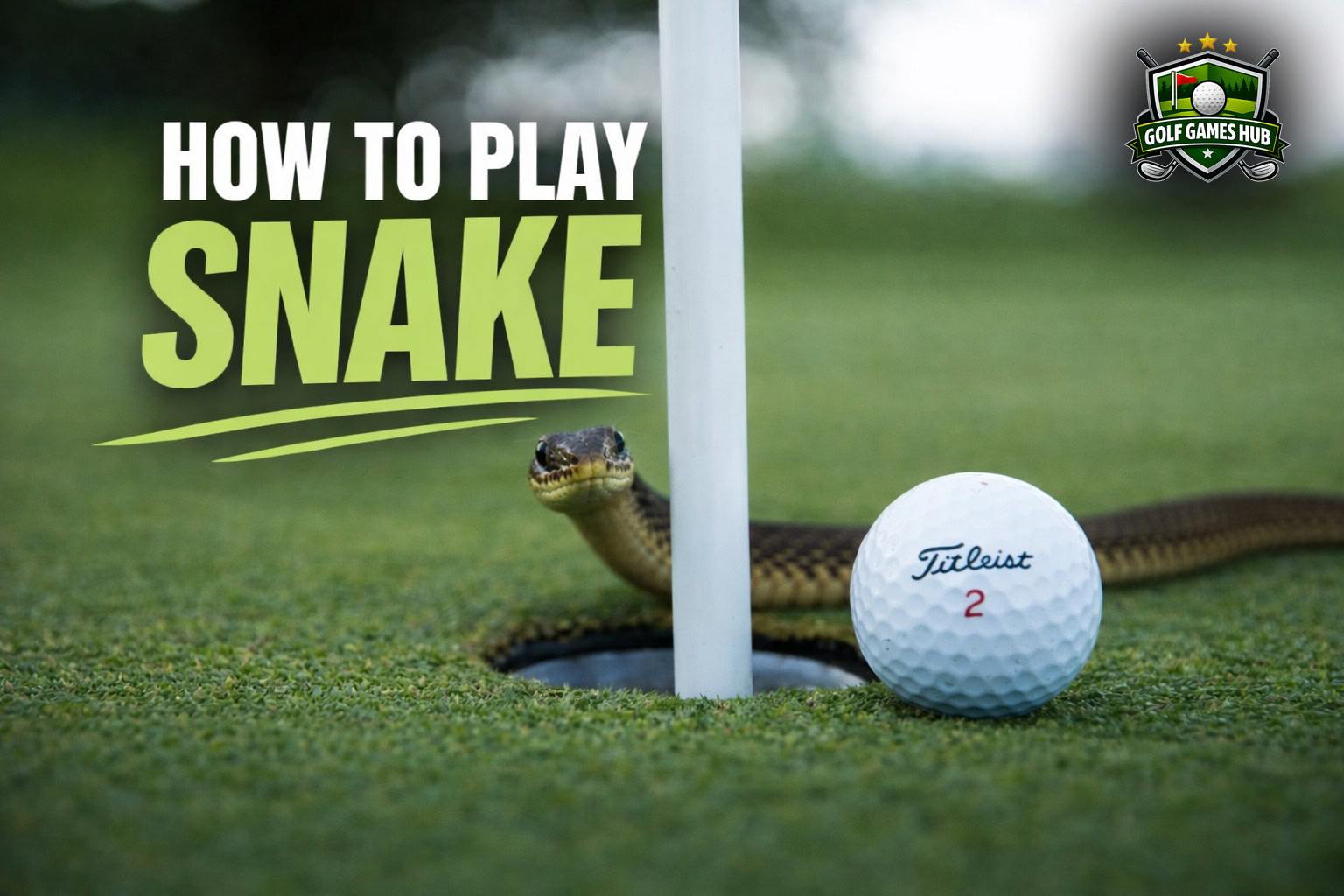
The Snake golf game is a putting-focused side bet where the last player in your group to three-putt is the loser — and depending on how your group bets it, that can mean buying the beers or taking a serious hit to the wallet.
It’s simple, it runs alongside any format you’re already playing, and it makes every putt on every green feel like it actually matters. Which is kind of the point.

What Is the Snake Golf Game?
Snake is a side betting game built entirely around one goal: don’t three-putt, and if you do, you better hope someone else does the same after you.
Works with 2–4 players (best with 4). Requires zero setup, no scorecards, no handicap math — just putts and consequences.
The “Snake” is a title passed between players every time someone three-putts, and whoever is holding it when the 18th hole is finished pays the group. Simple as that.
It’s one of the most popular add-on games in casual golf for good reason: it doesn’t interfere with whatever else you’ve got going, it creates real pressure on the greens all the way to the last hole, and it produces the kind of moments people talk about at the bar for years. (If your group’s add-on game is something you drink for instead of pay for, our F the Golfer drinking game is the rotating-pressure format you need.)
Now let’s get into how it actually works.
Game Setup
Number of Players: Snake can technically be played with as few as 2 players, but it’s best with 3 or 4. More players means more three-putt action, more snake transfers, and a bigger payout at the end.
Stake Agreement: Before the round begins, all players must agree on the bet structure. More on this in the rules section that follows.
Gimmes: There are none. Every putt must be holed out. This is non-negotiable. Allowing gimmes defeats the entire purpose of the game — Snake exists precisely because of those nasty 2.5-footers you’d normally just pick up.
Worth noting: under the official USGA putting green rules, gimmes aren’t a rules concept anyway — they’re an informal courtesy groups grant each other in casual play, and Snake is the game that takes that courtesy away.
Fringe Putts: Putts taken from the fringe or just off the green do not count toward the three-putt total. If your ball is technically off the green surface, your strokes on that hole don’t factor into Snake. Only strokes taken from on the green count as putts.
Order of Play: Standard golf etiquette applies — the player furthest from the hole putts first. Do not putt out of turn to try and game the Snake. Your partners will notice. And hate you.
Tracking: Designate one player to track the Snake on the scorecard. Mark who holds it after each hole where a three-putt occurs. Some groups use a physical token — a poker chip, a ball marker, or (the chaotic option) an actual rubber snake that gets thrown at whoever three-putts. Highly recommended.

How to Play Snake: Rules & Scoring
Here’s how the game runs from the first green to the last.
Step 1 — First Three-Putt: The first player in the group to three-putt during the round picks up the Snake. They are now the Snake holder. No penalty yet — just the distinction, and the whole group knowing about it.
Step 2 — Passing the Snake: The Snake is a hot potato. Every time a different player three-putts, the Snake immediately passes to them. It doesn’t matter how many three-putts you’ve had overall — only the most recent one matters.
Step 3 — Same-Hole Three-Putts: If two or more players three-putt on the same hole, the Snake goes to whoever sinks their final putt last. This is why order of play matters. Do not putt out of turn.
Step 4 — Holes With No Three-Putts: The Snake stays with its current holder. Nothing changes. Move on to the next hole.
Step 5 — End of Round: Whoever is holding the Snake after the final putt drops on hole 18 is the loser. Full stop. Doesn’t matter if you three-putted 10 times — if someone did it after you, you’re clean. The loser pays based on the agreed betting structure.
The Three Betting Structures in Snakes
Flat Bet: The simplest version. Agree on a fixed amount before the round — say $5. The player holding the Snake at the end owes each other player that $5. In a foursome, the loser pays out $15 total.
Doubling Pot (The Dangerous One): This is where Snake gets real. The group agrees on a starting amount — let’s say $1. Every time the Snake transfers to a new player, the pot doubles. First transfer: $2. Second: $4. Third: $8. After 8 transfers, the loser is paying out $128 to each player. That’s $384 total. From a $1 starting bet.
Use the doubling version with care. Start small — a nickel or a dime is not a joke. With a 10-cent starting bet and 10 three-putts in the round, the loser owes $12.80 to each player. It adds up fast, especially in groups with higher handicappers who are more likely to rack up three-putts.
Of course, a cap on the amount is advisable. If you’re into golf games with large pots, check out our Bounty game.
Pot Version: Some groups play a variation where each three-putt adds a fixed amount to a shared pot, and the Snake holder at the end pays out the entire pot to the other players evenly. Example: $2 per three-putt, 10 total three-putts in the round = $20 pot. The loser pays that $20 which gets split among the other players.
Tiebreaker / No Three-Putts: If nobody three-putts the entire round (rare, but it happens), there is no Snake and no payout. Buy each other a beer and celebrate collectively.

Snake Golf Game Variations
The Rubber Snake: Not really a rules variation, but worth mentioning — bring a physical rubber snake to the course. Whoever holds the Snake has to hang it from their bag. You’d be amazed how much additional psychological pressure a $3 party store snake creates.
Doubling with a Cap: For groups who want the doubling drama but don’t want anyone getting destroyed financially, agree on a maximum payout before the round. Once the pot hits a cap (e.g., $50), the amount stops growing.
Most Three-Putts Loses: An alternative scoring approach where the player with the most three-putts in the group pays out — not just the last one. This version is less about the final hole drama and more about overall putting consistency across the round.
Snake Over Multiple Rounds: If you’re on a golf trip, run the Snake over the entire trip instead of resetting each round. Whoever holds it when the last putt drops on the final day of the trip is the loser. The stakes stay low per round but the tension builds all week.
Two-Putt Snakelet: For scratch players or putting masochists — any two-putt on a hole shorter than 10 feet constitutes a “snakelet” worth half the Snake value. Adds a whole new layer of green reading anxiety.


Get the Snake Scorecard
Free
Instant PDF · Print at home · Take it to the course
Tips & Strategies
Winning Strategies
Lag putting is your best friend. Most three-putts start with a terrible first putt — either blowing it 8 feet past or dying short and leaving yourself a tough comebacker. Prioritize getting your first putt inside 3 feet. Distance control matters far more in Snake than making dramatic long putts. The PGA of America’s pace-of-play tips reinforce this — good lag putting is one of the simplest ways to keep your group on time.
Read the green before you mark your ball. In casual rounds, most players barely look at their approach angle. In Snake, give yourself an extra 20 seconds on every long approach putt. The difference between a 2-footer and a 6-footer for your second putt is often just a committed read.
Be a low-key menace on the final holes. If someone else is holding the Snake going into holes 15-18, their pressure is your advantage. You don’t need to do anything — just make your putts. Their anxiety compounds naturally.
Know the fringe rule and use it. If your approach runs just off the green, don’t panic. Your strokes from the fringe don’t count as putts. Bump it up close from there and two-putt safely. That fringe rule can save you from a Snake scenario more than once a round.
Pay attention to who’s away. If two players both look like they might three-putt on a given hole, the player who putts last (the one closest to the hole) has the advantage — they can see how their playing partner fared and know whether the Snake is already transferred before they putt.
Common Mistakes to Avoid
Starting the doubling bet too high. This is the #1 mistake new Snake groups make. Set the starting amount at a dime or a quarter for your first time playing with doubling. You’ll still feel every putt. You won’t risk a $200+ payout.
Forgetting the fringe rule mid-round. Someone will inevitably claim they three-putted from just off the green. Agree before the round whether fringe strokes count — the standard rule says they don’t, but your group needs to be on the same page before the first tee.
Relaxing after someone else three-putts. The most dangerous trap in Snake is feeling safe because a playing partner just transferred the Snake to themselves. You are one three-putt away from taking it right back. Stay sharp.
Taking the game too seriously on the first few holes. Snake doesn’t really heat up until the back nine. Don’t adjust your entire putting strategy on hole 2 and end up rushing. Play your game, stay calm, and let it matter when it actually matters.

Frequently Asked Questions
What is the Snake in golf?
The Snake is the name given to the player who most recently three-putted during a round. The title passes between players each time a new three-putt occurs, and whoever holds it at the end of the 18th hole loses the agreed-upon bet.
Can you play the Snake golf game with 3 players?
Yes — Snake works fine with 3 players. (And if a threesome is your usual setup, our full 3-player golf games collection is built for you.) The loser still pays each of the other two players the agreed amount. With fewer players, you’ll likely see fewer total three-putt transfers throughout the round, but the tension is just as real.
Are gimmes allowed in Snake?
No. Gimmes are not allowed in Snake. Every putt must be holed out. Allowing gimmes completely undermines the game since short putts are exactly what Snake is designed to pressure.
Can you play Snake alongside another golf game like Skins or Nassau?
Yes, and this is actually the most common way Snake is played. It runs as a side bet on top of whatever format your group is already using. One player tracks the Snake separately — it doesn’t interfere with Skins scoring, Nassau points, or anything else. If you like a hot-potato side game that gets passed around the group, here’s how to play Rabbit (catch it and hold on!).
How does the doubling Snake bet work?
The group agrees on a starting dollar amount (start small). Every time the Snake transfers to a new player, that amount doubles. If the Snake is transferred 8 times starting from $1, the losing player owes each other player $128. Starting from a dime with 10 transfers means the loser pays $12.80 to each player.
What happens if nobody three-putts in Snake?
If no player three-putts during the round, there is no Snake and no payout. Everyone walks off free. It’s rare but it happens — and it’s a completely valid outcome.

Final Thoughts
Snake is one of those games that seems almost too simple until you’re standing over a 4-footer on 17 knowing you’re holding it and everyone’s watching. That’s the magic of it. It turns a routine second putt into a moment with stakes, and it does it without adding a single minute to your round or requiring a single piece of extra math.
Run it alongside your next Nassau or Skins game and watch how differently everyone approaches the greens. Then go home and practice your lag putting. You’ve been warned.
Other Golf Games You’ll Love
Golf Games Hub is home to every golf game imaginable. Explore our various collections of golf games:
- Traditional Golf Games
- Fun & Social Golf Games
- Points-Based Golf Games
- Betting Golf Games
- Drinking Golf Games
If Snake is your speed, these formats deserve a spot in your regular rotation.
Split Sixes — A 3-player format that rotates partnerships every hole, with 6 points up for grabs each time. Nobody gets comfortable, alliances shift constantly, and the player who gets caught alone against two hot opponents pays for it immediately. If you love the individual accountability Snake creates on the greens, Split Sixes brings that same energy to the entire hole.
Alternate Shot — The most pressure-packed team format in golf. You and your partner share one ball, trading shots until it’s in the hole — which means your partner’s 40-yard pull into the rough is now your problem. Snake punishes bad putting. Alternate Shot punishes everything. Ryder Cup players do this for a reason.
The Bounty — A Golf Games Hub original. Every hole carries a pot, and the only way to collect it is to win the hole outright. Tie for low score? The pot doesn’t pay out — it rolls over and doubles. Then it doubles again. By the time someone finally wins a hole clean, you’re looking at a jackpot that can flip an entire round in a single swing. It’s one of the most addictive betting formats on this site, and it pairs with Snake perfectly — two games that make every single shot feel like it actually costs something.
Chapman — A 2-vs-2 team format with a unique twist: both partners hit drives, swap balls for the second shot, then choose the best of the two to finish out as a team. It’s collaborative without letting anyone hide, and it produces the kind of moments where one spectacular recovery shot completely swings a hole. A great format to pair with Snake when you’ve got a foursome.
Murphys — The chip-and-putt cousin to Snake. Call a Murphy off the green and bet you’ll get up and down; make it, collect from everyone, miss it and pay the table. Snake punishes three-putts, and Murphys punishes soft short games. Run them together and there’s nowhere on or around the green where you can hide. If you’d rather keep the putting bet dead simple, our Low Putts post covers the most stripped-down putting side bet there is.
We add new games every week, so come back again soon. Your new favorite golf game awaits!
Thanks for stopping by.