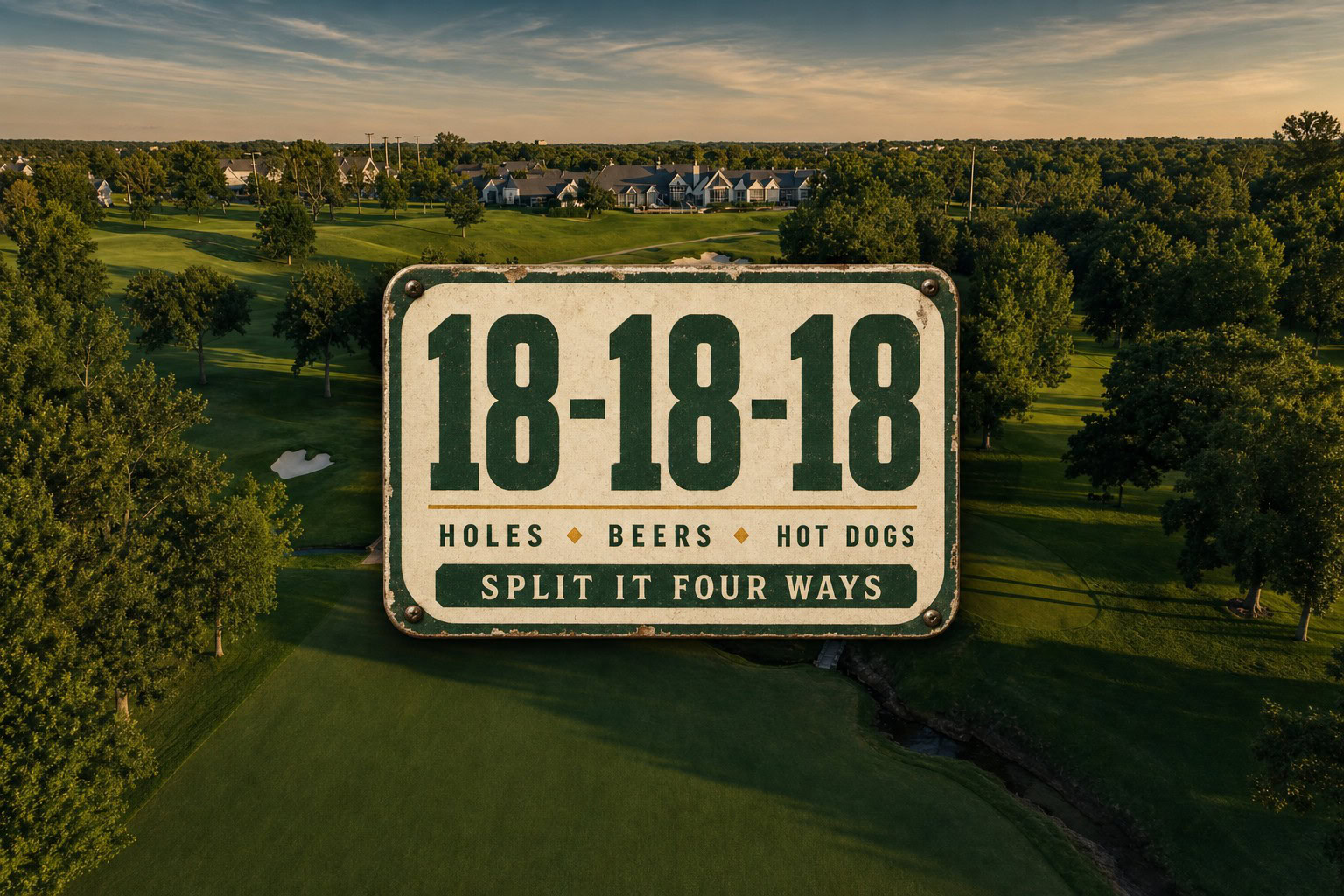


Umbrella is a 2-vs-2 golf game where five things are up for grabs on every hole, and the points you win are equal to the number of the hole you’re playing.
A point on the 1st hole is worth one. A point on the 18th is worth eighteen. So the lost point you barely felt on the front nine can decide your whole afternoon on the back.
If one team runs the table on a single hole, the points double, and that sweep is called an “umbrella.” That’s where the game gets its name, and that’s where it gets dangerous.
This guide covers the full rules, the scoring, the variations you can play, and the mistakes that quickly empty your wallet on the closing holes.

Game Setup
Getting the table set right matters more here than in all the other betting games, because the stakes change as the round progresses.
Players Required
Umbrella is built for exactly four players in two teams of two. Pick partners however you like, by random draw, by handicap balance, or by who owes who from last week.
Handicaps
The default is straight gross scoring, which keeps the round easy and the achievements honest.
If your group has a real spread in ability, run it net instead and use our simple golf handicap calculator to set each player’s strokes before you start.
Scoring Triggers
On every hole, these five things are worth points:
- Low ball — the single lowest score among all four players
- Low total — the lower combined two-ball score between the two teams. If you’re unfamiliar, add the teams strokes together. That total is what we call the combined two-ball score.
- Green in regulation, player 1 — your first partner reaching the putting surface in regulation
- Green in regulation, player 2 — your second partner reaching the putting surface in regulation
- Birdie — either player on your side making birdie
The Point Value
Each of those five is worth the number of the hole being played. Every achievement on the 1st hole is worth one point. Everything on the 9th is worth nine. Everything on the 18th is worth eighteen.
Setting the Stakes
Settle one of two ways…
Either assign a dollar value per point and pay the difference at the end, or have all four players ante into a pot and let the team with the most points takes it.

How to Play: Rules and Scoring
This is the part that decides games, so read it like a rulebook and then we’ll walk through an example.
The Five Points, Defined
Two of the five points are head-to-head. Only one team can win them on a given hole:
- Low ball goes to the team with the single lowest individual score on the hole.
- Low total goes to the team with the lower combined two-ball score.
The other three are achievement points. Your side earns them for what your own players do, regardless of the other team:
- A green in regulation point is earned for each of your two partners who reaches the green in regulation. There are two of these available to your side every hole, one per player.
- A birdie point is earned if either partner on your side makes a birdie.
A green in regulation means your ball is on the putting surface in at least two strokes fewer than par. That’s one shot on a par 3, two on a par 4, and three on a par 5. The ball has to be on the green itself, not the fringe. This is the same standard the PGA Tour uses to track greens in regulation, and it’s the metric that quietly wins more Umbrella points than birdies do.
Scoring the Points
Add up the points each side earns on every hole and carry a running total. Because the values climb with the hole number, the back nine is where the score actually gets decided. The first eight holes hand out a maximum of 36 points per achievement category combined. The 18th hole alone puts 90 points in play on one hole.
Ties wash. If both teams tie a category, nobody scores it. If both teams post the same low individual score, that point is gone for both sides rather than awarded twice. The same goes for low total and birdie.
The Umbrella: Where the Points Double
You score the umbrella when your side claims all five point-earners on a hole and the other team comes away with nothing. Win low ball, win low total, have both partners hit the green in regulation, and make at least one birdie. If the other team fails to record a single green or a birdie of their own, you’ve swept the hole, and your points for that hole double.
A tie on any category kills the umbrella, because a sweep means the other side scores zero, and a tie hands them a share.
A Worked Example
Say you’re on the 7th hole, a par 4. Every point here is worth seven. You and your partner are Team A. Your opponents are Team B.
- You hit the green in two and roll in the putt for birdie (3).
- Your partner hits the green in two and two-putts for par (4).
- One opponent misses the green, chips on, and bogeys (5).
- The other opponent misses the green, chips on, and saves par (4).
Now score it. Your 3 is the low ball, worth 7. Your team total of 7 beats their 9, worth 7. You hit the green, worth 7. Your partner hit the green, worth 7. You made birdie, worth 7. That’s all five. Their side recorded no green in regulation and no birdie, so they scored nothing. You swept the umbrella: 35 points doubles to 70.
Now replay it with one change. The opponent who saved par does it by hitting the green in regulation and two-putting instead of chipping on. Your side still earns all five of its own points for 35. But now their side has a green in regulation worth 7, so they’re not blanked. No umbrella. You take 35, they take 7.

Game Variations
The core game is solid, but consider bending it to fit your crew. Here are the variations worth knowing.
Net Umbrella. Run every category off net scores. Net low ball, net low total, and net birdies, where a player getting a handicap stroke allowance who makes a natural par is credited with a net birdie. Decide before the round whether a player getting a stroke who reaches the green a shot late still counts for a green in regulation. Most groups say no, and keep the green-in-regulation points gross even when everything else is net.
Add-on accomplishments. Some groups widen the umbrella by adding more point-earners, like longest drive in the fairway, closest to the pin on par 3s, or sand saves. Just remember that the more categories you add, the harder a clean sweep becomes, so the umbrella shows up less often.
Head-to-head greens. Instead of scoring greens independently, some play the two green-in-regulation points as a single head-to-head contest: the side with more greens on the hole wins both points, and an equal number washes. This keeps the math tighter but removes the “spoil the sweep with one green” wrinkle that makes the standard game tense. It’s a cleaner ruleset for a group that hates arguments.
Flat-point Umbrella. Not every group wants 90 points riding on the 18th. Play every category for a flat one point all round instead of scaling by hole number. You keep the five categories and the doubling sweep, but the back nine stops being a financial cliff.
Six-Point Scotch. A close cousin runs four categories worth six points total (two for team total, two for low ball, one for closest in regulation, one for birdie) with the same sweep-doubles rule. If your foursome likes stacking up team money on every hole, check out SWAT. It’s a 2-vs-2 game born at Oakmont that plays in the same spirit.

Tips and Strategies
Knowing the rules keeps you in the game. These keep you ahead of the players who only know the rules.
Winning Strategies
Price the bet off the 18th hole, not the 1st. This is the whole game in one sentence. A dollar a point feels like a friendly Nassau on the opening holes and turns into ninety dollars on a single hole at the end. Set a number you’d be comfortable losing on the closing stretch and work backward.
Treat the green as the prize, not the pin. Two of your five points come from reaching the putting surface. The team that consistently puts both balls on the green wins more Umbrella holes than the team chasing flags and short-siding itself. Aim for the fat of the green and let the points pile up.
Spend your risk on the high-numbered holes. A birdie gamble worth three points on the 3rd is not the same bet as one worth sixteen on the 16th. Take the safe play early when the points are small, and pick your aggressive moments late when they’re worth real money.
Common Mistakes to Avoid
Banking on the umbrella instead of the steady points. Sweeps feel like the heart of the game, but against decent opponents they’re rare. Most matches are decided by who quietly wins more low-ball and low-total points across 18 holes, not by one dramatic double. Chase umbrellas while forgetting the low hanging fruit and you’ll lose a match you should have won.
Letting one blow-up hole snowball. Low total runs off the combined two-ball, so a single 8 on a par 4 can sink the point even when your partner pars. When a hole goes sideways, take your medicine and protect the next shot instead of compounding it into a bigger score.

Frequently Asked Questions
How do the two green-in-regulation points actually work in Umbrella?
Each side scores its green-in-regulation points independently, one for each partner who reaches the putting surface in regulation. Both teams can earn greens on the same hole. That independence is what creates the signature Umbrella moment: a team can win low ball, low total, and a birdie and still be denied the doubling umbrella because a single opponent got onto the green for one green in regulation.
What counts as a green in regulation on a par 3 versus a par 5?
A green in regulation means your ball is on the putting surface in at least two strokes fewer than par. That’s the green in one shot on a par 3, two shots on a par 4, and three shots on a par 5. The ball has to be on the green itself. The fringe does not count, even if you’d putt from there.
Do you use handicaps in Umbrella, and do birdies count net?
The standard game is gross, which keeps every achievement straightforward. If your group plays net, agree up front that a player getting a stroke who makes a natural par is credited with a net birdie, and decide whether a late green still counts as a green in regulation (most groups keep that one gross).
Can you play Umbrella with 3 players?
No. Umbrella is a 4-player, 2-vs-2 game. The low-total category and the two separate green-in-regulation points are built around two-player teams, and there’s no clean way to split a threesome that keeps the scoring fair. If you’re a group of three, play a format designed for it instead. Look through our best golf games for 3 players.
What happens if both teams tie a category?
Nobody gets the points. A tied category washes for both sides rather than paying out twice or carrying over. A tie also means the hole cannot be an umbrella, since a sweep requires the losing side to score zero.
Is the “hole number” the scorecard number or the handicap stroke index?
The literal scorecard hole number, 1 through 18. The 1st hole you play is worth one point per category and the 18th is worth eighteen, regardless of how the holes are ranked by difficulty on the card.

Final Thoughts
Umbrella is the rare side bet that makes the late holes, where most people check out, the most important ones on the course. The front nine is where you set the table. The back nine is where you eat.
Play it once with the points scaling by hole, and you’ll feel the 16th, 17th, and 18th in a way no flat bet ever could. Grab three buddies this weekend, set a sane wager, and find out who actually shows up when the points get big.