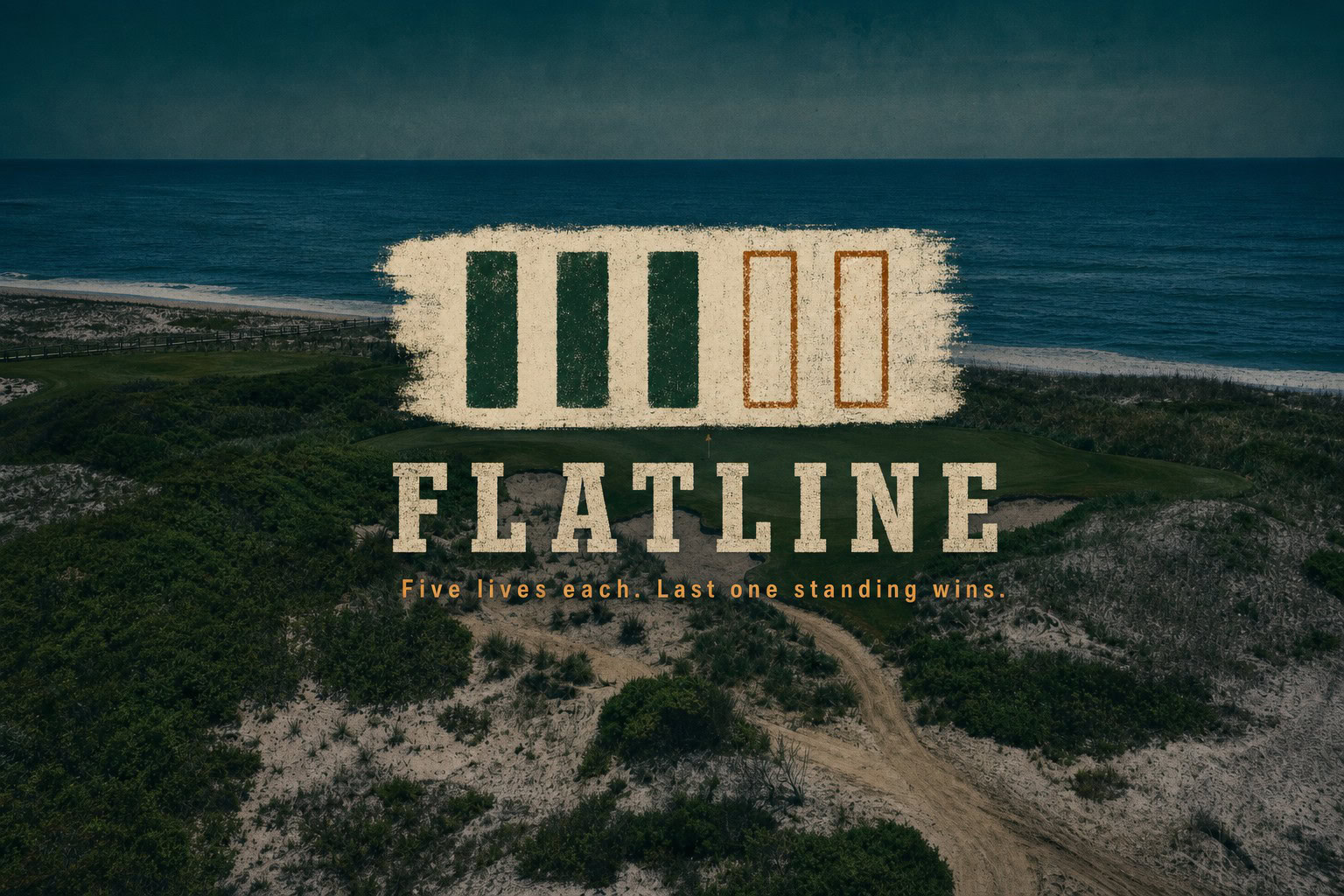
Flatline is a head to head golf game where you win by running your opponent out of lives. You each start with five, you lose one every time you lose a hole, and the first player to zero is out even if the round isn’t finished.
What separates it from a straight countdown is that lives come back. Win two holes in a row and you earn one back, up to your original five. A player who looked finished can be right back in it a couple of holes later.
A tie breaks that streak, which turns a halved hole from a non-event into a real outcome.

MORE GAMES WHERE BEING BEHIND ISN’T OVER
Formats that keep the trailing player interested to the last green:
Setting Up Flatline
Two players and somewhere to track two life counts that change on almost every hole. Both numbers have to stay visible to both players, and a course scorecard has nowhere to put them. Our printable scorecards for individual games keep the two counts side by side instead of buried in a corner.
The skill this format actually pays for is the ability to stop a slide, since two lost holes in a row hand your opponent a life back on top of the damage. That’s a training problem as much as a playing one, and our scored practice games and drills are organized around finding the leak that produces those runs in the first place.
Two similar players can run it off gross scores. If there’s a gap between you, switch to net and decide each hole on net scores. Our golf handicap calculator gives you a course handicap each, and how a golf handicap is calculated covers where those numbers come from.
WHERE A STROKE IS WORTH MOST
A handicap stroke is worth more on defense than on offense here. Turning a loss into a halve saves you a life and wipes your opponent’s streak at the same time. Turning a halve into a win only does one of those.
A penalty stroke that turns a halve into a lost hole costs a life outright. That’s a heavier price than the same stroke carries in most formats. Our guide to golf penalties sorts the one-stroke situations from the two-stroke ones.
Flatline works fine as a straight match with nothing riding on it. If you want money involved, there’s a betting version further down.


Get the Flatline scorecard
$2.99
Instant PDF download · Print at home · Yours forever

How Lives Move in Flatline
Losing a Life
Play each hole head to head. Whoever loses the hole loses a life. Tie it and nothing moves.
- You win the opening hole — they drop to 4
- They win the next — you drop to 4
- The one after is halved — both stay at 4
Winning One Back
Win two holes in a row and you take a life back. The damage still lands on both of those holes. Your opponent drops two while you climb one.
Consecutive wins are counted in pairs. The first win pays nothing, the second earns a life, the third pays nothing, and the fourth earns another. A four-hole run recovers two lives at most.
A halved hole resets the count to zero. The two wins have to be outright and back to back. Lives also cap at five. A run by a player who hasn’t lost a hole yet earns them nothing.
Say you’re on 2 lives and your opponent is on 4. You win a hole and they drop to 3.
You win the next and they drop to 2, and the streak pays you a life that takes you to 3. Two holes have moved you from two lives behind to one ahead.
All of which puts real weight on the hole straight after you drop one. These four steps for bouncing back after a bad hole are worth having in your pocket for exactly that situation.
Hitting Zero
The moment a player reaches zero they’re out and the match is over, holes remaining or not. That’s a Flatline.
Both players then reset to five and whatever holes are left become a fresh match. If the first one finishes with only a handful of holes to play, the second rarely produces another elimination and tends to get settled on lives remaining instead.
If neither of you reaches zero across 18 holes, the player with more lives left wins. Level on lives and it’s a draw.

Why a Lead Is Hard to Convert
Two rules in this format do more work than they look like they do, and both of them favor the player who’s behind.
The Cap Does the Work
Lives stop at five. A player who hasn’t lost a hole is already sitting on five, so winning two in a row earns them nothing at all. The same two-hole run is worth a full life to somebody down at two.
Regeneration only pays a player who has already been hurt. That makes it a catch-up mechanism rather than a reward for playing well, and it’s the reason a big early lead is worth less than the count makes it look.
Why a Halve Is a Weapon
In match play a halved hole is a non-event for both players. Here it does two jobs for whoever is behind. It costs them nothing, and it wipes their opponent’s streak count back to zero.
So a player on one life should be playing for halves. Grinding out a bogey to match a bogey keeps them in the match and denies the other player a life they were one hole from earning.
THE ONE HOLE TO PRESS
Press hardest on the hole after you’ve just won one. That’s the hole carrying a life bonus on top of the damage, and it’s the only time in the game a single hole is worth two lives.
Playing not to lose is an active move in this format rather than a passive one, which is an unusual thing to be able to say about a golf game.


Every scorecard.
Built for every format.
- Download them. Print them. Take them to the course.
- Dedicated layouts specific to each game.
- Buy once. Print forever. All future cards included.
$9.99
or the Flatline card — $2.99
(no generator with single card purchase)
★Card generator included. Add your course’s yardages, pars, and handicaps.

Five Ways to Change Flatline
None of these belongs to the base game. Each one shifts how long a match runs or how much of a chance the trailing player gets.
Sudden-Death Tiebreaker
If you both finish 18 on the same number of lives, keep going. First player to win a hole outright takes the match.
It costs nothing until it’s needed, and it suits a format where a drawn match feels like an anticlimax.
No Regeneration
Take the two-in-a-row rule out entirely. Every life you lose is gone for good.
That’s the fast and ruthless version. It also strips out the only catch-up mechanism in the game. A clearly stronger player then wins most of the time and matches tend to finish well short of 18. Use it when you want a short, decisive contest.
Different Starting Lives
Three lives makes it aggressive and short. Seven makes it forgiving and long enough that it’ll usually go the distance.
Five is the default, and it’s the number that makes an 18-hole round land about right.
Comeback Bonus
A player down to exactly one life earns an extra life for winning the next hole, on top of anything the streak rule pays them.
Worth knowing that the base game already leans this way, since the life cap means regeneration only ever helps the wounded player. Add this one if you want that effect turned up, not because the game is short of a comeback.
Betting Version
Agree a figure per Flatline. Whoever gets knocked out pays it, and if the reset produces a second match inside the same round, that one pays out too.
The money settles on eliminations rather than trickling out hole by hole. Pick a dollar figure you’d still feel on the drive home. Twenty is a good starting point among golf games for 2 players, where a per-hole bet of the same size would run away from you.

Who Flatline Actually Suits
It works best between two players close enough that holes actually get traded. Regeneration needs somebody to string two together, and a mismatch where one player takes most of the front nine just ends the match early.
It’s weaker between two grinders who halve everything. A round full of ties barely moves the count, and you finish on a four-to-three decision that neither of you really felt.
The starting number fixes both problems. Drop to three lives against a stronger player and they still have to close it out under pressure. Go to seven if you’re the sort of pair who halves half the card.
Screenshot the reference card above so the streak rule and the reset are on hand while you play.
Worth a run this weekend. Bring somebody who doesn’t quit.