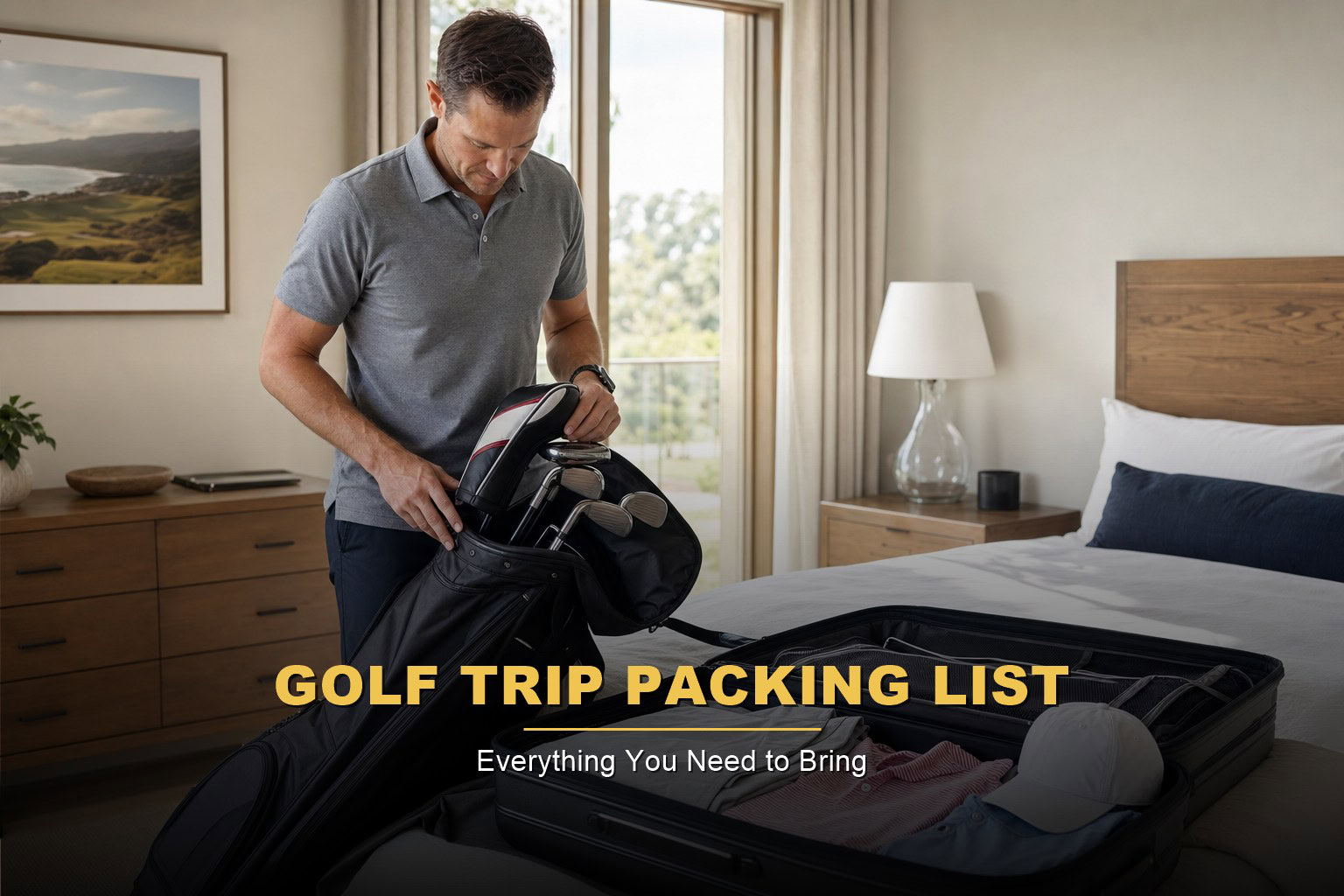
A golf trip packing list works best when you build it in groups instead of one long dump of items.
You have to get your clubs to the course in one piece and pack the gear you actually play with. Then come the clothes for the weather and the easy-to-forget health and document items that sit on the counter at home.
This is the pack-ready version, sorted so you can run down each list and check things off.
This post stays on packing and nothing else. The bigger calls on crew, destination, budget, and the weekend competition can be found in the complete guide to planning a golf trip, if you want the full assist.
Some links in this post are affiliate links. If you buy through them, we may earn a small commission at no extra cost to you.

Getting Your Clubs There in One Piece
The travel bag is the first decision. A hard case with a molded shell protects best against baggage handlers, and it is the only type some airlines will cover on a damage claim. A soft case is lighter, cheaper, and easier to store at home, and it saves you 5 to 8 pounds that can keep the whole thing under the typical 50-pound checked-bag limit.
Frequent flyers with expensive clubs lean toward a hard case. If you travel once or twice a year, a well-padded soft bag does the job fine.
Pad the bag before it ever hits the belt. Drop a stiff arm (a golf-club support pole that sits taller than your driver) or a tightly rolled towel down the bag so it takes the impact when the bag lands, not your longest club. Weave a towel or bubble wrap between the shafts so they do not rub in transit, and keep the head covers on your driver and woods.
You can also ship your clubs ahead. A shipping service like Ship Sticks delivers them to the resort with tracking and insurance, so you skip the airport haul and the baggage-claim wait, often at a price close to the airline fee.
Most US airlines treat a golf bag as a standard checked bag within the normal weight and size limits. A third bag or an overweight bag triggers extra charges, so confirm your carrier's policy before you fly.
- Travel bag, hard case for max protection, soft case to save weight.
- Stiff arm or rolled towel, the tallest point that absorbs the drop instead of your driver.
- Head covers, on the driver and woods to stop shaft-on-clubhead contact.
- Luggage tag, with your name and phone number, inside and out.
- Airline policy or shipping label, confirmed and printed before you leave.

Golf Gear to Pack
This is the stuff that goes in and around your bag. On a multi-day trip you burn through more of it than you expect, so bring spares of the things that wear out or get lost.
- Golf balls, more than you think, plan on a sleeve or more per round because a resort course and a couple of drinks find water you did not know was there. These are my go-to.
- Gloves, bring spares, they wear out and a wet one is useless for the back nine. This is the soft, durable one I play.
- Tees, a full pack, they vanish faster than balls do.
- Ball markers and a divot tool, small, easy to forget, annoying to buy at pro-shop prices.
- Rangefinder or GPS, plus its charger or spare batteries, since the batteries always die on the trip and never when it's convenient. The one I carry gives true yardage every time.
- Extra spikes or a spare pair of golf shoes, a soaked pair takes a full day to dry, and a second pair keeps you playing.
- Rain suit and umbrella, a wind-resistant umbrella doubles as sun shade, and a packable rain jacket saves a round.
- Golf towel, one to clean clubs and hands, and it is a welcome possession on a hot day.

On-Course Apparel by Weather
Pack for the weather your destination actually gets rather than the season back home. If you have not locked the location yet, the golf trip planning guide walks through choosing the best fit for your crew. Once you know where you are headed, a good default is one polo per round plus one extra for evenings or a surprise change in the forecast.
- A layer for cool mornings, a quarter-zip or light sweater you can shed by the turn.
- Moisture-wicking polos, one per round, plus a spare, in fabric that dries fast.
- Shorts and pants, shorts for warm days, tailored pants with some give for cool or dressy courses.
- A hat or visor, sun off your face for four-plus hours a day.
- Sunglasses and sunscreen, both stay in the bag, not the hotel room. The pair I wear has a frame you forget is there.
- Rain gear again, for wet regions, a water resistant jacket and a spare glove beat toughing it out.

Off-Course and Evening Clothes
The rounds are only half the trip. Most groups grab dinner somewhere a step up from the halfway house, and a resort or nicer restaurant will expect more than a sweaty golf polo.
- A collared shirt or two, for dinners with a dress code, separate from your on-course polos.
- Casual clothes, jeans or chinos and a couple of tees for downtime and travel days.
- Comfortable walking shoes, your feet are done with spikes after 18 holes, give them a break.
- Swimwear, if the resort has a pool or the trip touches a beach.

Body and Health for Multi-Day Golf
Three or four rounds in a row is more mileage than most golfers put on their body in a normal week. A small kit keeps a blister or a stiff back from forcing you to take a day off the schedule.
- Sunscreen and lip balm, high SPF, reapplied through the round, with SPF balm for your lips.
- Anti-inflammatories, for the back and knees that add up over consecutive days.
- Blister care and tape, bandages and athletic tape, because new shoes and 72 holes do not mix well.
- A brace or two, if a wrist, elbow, or knee already gives you trouble, pack the support you know you need.
- Hydration, a water bottle and electrolyte packets, especially in heat or at altitude. I swear by my Owala bottle and that electrolyte powder.

Tech and Documents
The small pouch of chargers and paperwork is the part people rush past, and it is the part that actually strands you. Sort it the night before so you are not scrambling at the gate.
- Chargers and a battery pack, phone charger plus a power bank for long days away from an outlet.
- Rangefinder charger/batteries, the one nobody packs, and the one you will want on day two.
- ID and confirmations, driver's license or passport, plus your resort and tee-time confirmations saved offline.
- Cash, for tips, the caddie, and settling the games at the 19th hole.
- A card, a credit or debit card for the pro shop, dinners, and anything cash does not cover.
The Items Golfers Leave Off Their Golf Trip Packing List
These are the four that get left behind most often. None of them is expensive at home and all of them are a hassle, or expensive, to solve at a resort.
- A spare glove, the first thing to fail and the last thing anyone packs a backup of.
- Sunscreen, always in the bathroom at home, never in the bag.
- A phone charger, or the cable for it, which is somehow worse.
- Cash for the caddie, a card does not tip a looper, and there are no ATMs to be found at a golf course.
Golf Trip Packing Questions Golfers Ask
Should you ship or fly with your golf clubs?
Fly with them when cost is the priority, since checking a bag is usually the cheaper option. Ship them when you want to skip the airport haul, you are making tight connections, or you are carrying high-value clubs you want insured and tracked door to door. On many routes the shipping price lands close to the airline fee, so it comes down to convenience versus a few dollars.
Can you carry golf clubs on a plane?
No. A full set of clubs is too long for the overhead bin and the cabin, so it goes in the hold as checked baggage or sports equipment. You can carry on smaller items like your rangefinder, a glove, and your shoes, but the clubs themselves get checked in a travel bag.
How many golf balls should you pack for a golf trip?
Plan on at least a sleeve of three per round, and a dozen or more for the trip. Unfamiliar courses, water you cannot see off the tee, and a looser swing after a beer all cost you balls you would normally keep safe at home. Running out mid-trip means paying resort pro-shop prices, so overpack this one.
Is a hard or soft travel bag better for flying?
A hard case protects better and is the type some airlines require for a damage claim, which makes it the safer pick for expensive clubs or frequent flyers. A soft case is lighter and cheaper and works well for occasional trips, especially paired with a stiff arm and towels packed around the shafts. Either way, the padding inside matters as much as the shell.
What should you wear to dinner on a golf trip?
Pack a collared shirt and chinos or clean jeans that are separate from your on-course polos. Most resort restaurants sit at smart-casual, so a fresh collared shirt and non-athletic shoes cover almost every dinner. Check the dress code wherever you have a reservation before you go, since a few private clubs still require a jacket.

Pack It Once, Reuse It Every Trip
Run down these lists the night before, and you will not be the one buying a $20 sleeve of balls in the pro shop or hunting a non-existent ATM at the first tee. Save the list, and next trip you only have to adjust for the weather and the number of rounds.
Once the bag is packed, the rest of the trip is the fun part. If you still have crew, destination, or the weekend's golf formats to sort out, the guide to planning a buddies golf trip covers all of it.