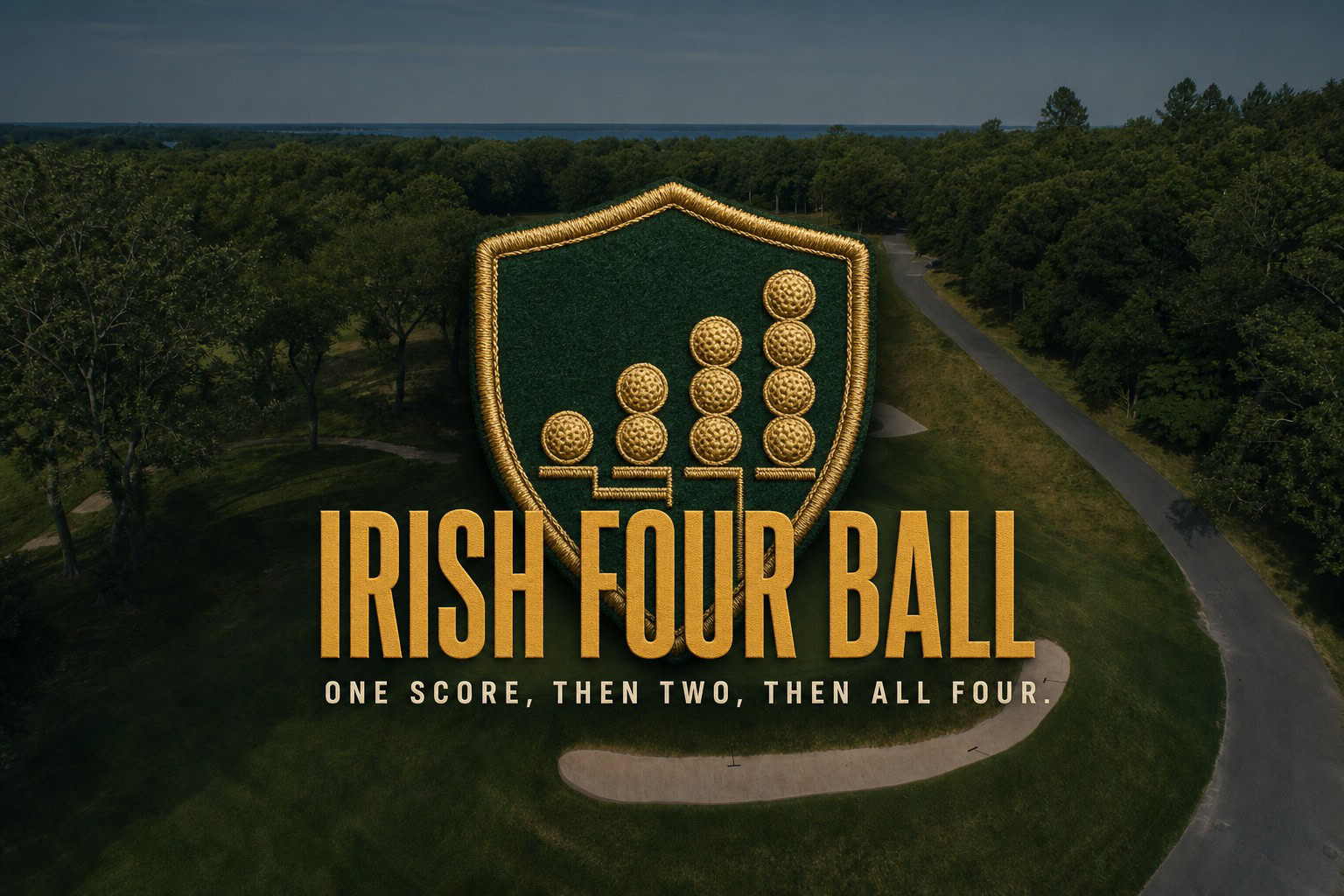
Irish Four Ball counts more of your team’s scores as the round goes on. One score decides the opening holes, two through the middle, three after that, and on the closing stretch every player’s score counts.
It is almost always scored with Stableford points rather than strokes, which is important. The escalating scoring only survives because a disaster hole is worth zero points instead of a big number.

MORE POINTS-BASED FORMATS
Three more games where you collect points instead of counting strokes:
- Modified Stableford — the Tour version, where an eagle is worth more than a double bogey costs
- Quota — you are handed a points target off your handicap and play to beat it
- Team golf games — the wider set of partner formats, sorted by how much a bad hole can cost you
How the Count Escalates
Four players to a team and everybody plays their own ball for the whole round, the same as an ordinary four-ball. What changes is how many of those four scores get added together on each hole.
The common split runs like this. Holes 1 to 6 count the single best score, holes 7 to 11 count the best two added together, holes 12 to 15 count the best three, and holes 16 to 18 count all four. Organizers move those boundaries around, and a tidier version splits the round into thirds instead.
A second version keys the count to the hole rather than the position on the card, so two scores count on every par 3, three on every par 4 and all four on every par 5. It produces a similar spread and it is easier for a field to remember, though it removes the build toward the finish that gives the format its shape.
Some events cut the one-score segment altogether so at least two cards count everywhere. That is the kinder setup for a field with a wide handicap spread, since no player spends any part of the round carrying the full team.
Scoring is Stableford throughout, played off handicaps. If you need help, our handicap calculator handles the allowance if your event is applying a percentage rather than full strokes.

Download the card above before you tee off, because the hole splits are the thing groups forget by the middle of the round.
Why It Uses Stableford
Requiring all four cards on the closing holes would be unplayable in stroke play. One player making a nine on the last hole would erase whatever the other three did, and a team with a genuine beginner in it would stop competing somewhere on the front nine.
Stableford puts a floor under the damage. A net double bogey scores nothing, and so does a net nine. The worst any player can do to their team on a hole is contribute zero, which is exactly what makes an all-four-count finish survivable.
That floor is also why the format tolerates a wide handicap range. A high handicapper receiving strokes will pick up a point here and there on the holes where they get help, and on the holes where everything goes wrong they simply add nothing rather than subtracting.

What the Escalation Does to Your Team
Plenty of team formats hide the weakest player for the entire round. Irish Four Ball hides them at the start and then asks them to deliver at the end, which is the reverse of what a nervous golfer would choose.
Through the opening stretch a single score carries the hole, so the fourth player can put three balls in the trees without costing anything. By the closing holes their score is mandatory, and the pressure lands on the person who has contributed least all day.
Two things follow from that. A lead built early is worth less than it looks, because the team that is behind at the turn has done its damage in the segment that mattered least. And the useful job for a captain over the closing holes is not squeezing out birdies, it is making sure the weakest player has a realistic path to one point on every hole.
In practice that means telling them to take the safe line and accept a net bogey. Golf.com has a good piece on limiting the damage when you find yourself in trouble, and it is worth reading by whoever in your team is going to be standing over a mandatory score late in the round. Our practice drills cover the recovery shots that turn a lost hole into a point.
CAPTAIN’S JOB
Order the tee shots so your weakest player hits after somebody safe. Watching a partner find the fairway is worth more to them than any advice you can offer on the closing holes.

Telling It Apart From the Other 1-2-3 Formats
Several team games move a counting number between one, two and three, and they get confused with each other constantly. The difference is what makes the number move.
Cha Cha Cha
The count rotates hole by hole in a repeating cycle of one, two and three. It never builds, so the last hole is no more demanding than the first and the pressure is spread evenly across the round.
Progressive Best Ball
Also called a Miami Scramble. The count escalates in thirds, one best ball for six holes, then two, then three. It shares the build with Irish Four Ball and stops at three, so some players aren’t always obliged to post a score.
Plain four-ball
One best ball on every hole from start to finish. The count never moves, which is why a strong player can carry a team through an entire round and why the format rewards a stacked pairing more than any of the others here.

Running It Without Confusion
Print the hole splits directly on the scorecard. A field told at the first tee that the count goes one, two, three, four will contain several teams adding up the wrong number of scores by the middle of the round, and sorting that out afterwards means recalculating cards you cannot verify.
Put the Stableford points table on the card as well. Plenty of players in a mixed field have never scored a round in points and will otherwise spend the front nine asking what a par is worth.
Decide the handicap allowance in advance and state it. Full handicap suits a social day, and a percentage allowance is the usual choice when there is a prize table involved.
Put the splits on the scorecard and the format runs itself. See you out there.