


Golf can be played many different ways.
But, if you’re wondering how to play Wolf…
Wolf is a rotating, hole-by-hole golf format designed for three or four players in which one player per hole assumes the role of the “Wolf.” The Wolf may elect to partner with another player for that hole or compete as “Lone Wolf” against the remaining players. The decision is made after seeing your group’s drives.
The format requires tactical decision-making before ever leaving the tee box.
On each hole, the Wolf tees off last and must decide—immediately after each opponent’s tee shot—whether to select that player as a partner or pass. If the Wolf declines all potential partners, the Wolf may play alone against the field for increased stakes.
Wolf rewards strategic judgment, disciplined shot execution, and situational awareness.
The sections that follow lay out the complete rules, scoring, and strategies to beat your golf buddies at this amazing social & fun golf game.

Quick Summary / TL;DR
Wolf is a four-player, rotating golf game played on a hole-by-hole basis. On each hole, one player serves as the Wolf.
Establish a tee order on the first hole and rotate it every hole so each player serves as Wolf an equal number of times. The Wolf always tees off last.
After each of the first three players hits a tee shot, the Wolf must immediately decide whether to select that player as a partner for the hole or pass. Once the Wolf passes a player, that player cannot be selected later.
If the Wolf selects a partner, the hole becomes a two-versus-two best-ball match. Each side counts its lowest individual score, and the lower best ball wins the hole.
If the Wolf passes all three players—or declares before teeing off—the Wolf plays alone (“Lone Wolf”) against the combined best ball of the other three players.
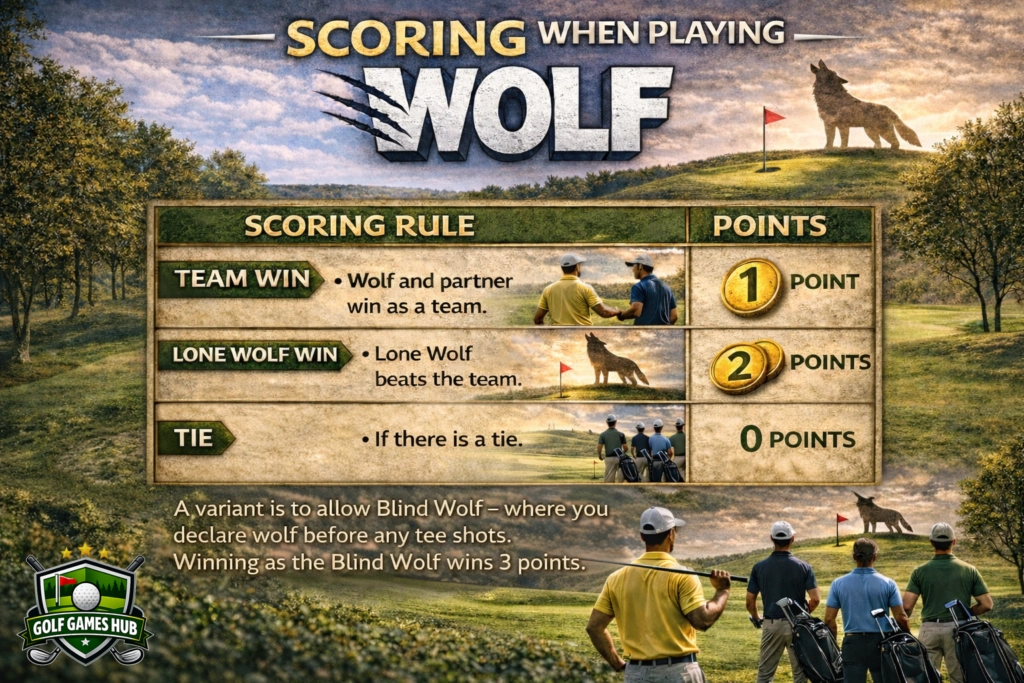
Before the round begins, agree on point values. A common structure is 1 point for a standard team win and 2 points for a Lone Wolf win.
At the end of 18 holes, total each player’s points. The player with the most points wins.
With tee order set, scoring agreed upon, and rotation understood, the group can begin play immediately.
If you want to learn some fun variations, strategies, and the full instructions for playing wolf, keep reading.
How to Play Wolf Golf Game
Below is a breakdown of how to play the Wolf golf game.
Number of players/teams required
Standard format is to play with four players. However, you can also play with three players (see Variations section).
- 2v2 (Wolf + their selected partner versus the remaining two players), or
- 1v3 (Lone Wolf versus the other three players).
Wolf Game Setup
- To begin, agree on the scoring basis: gross scoring or net scoring (handicap-adjusted). If net scoring is used, determine each player’s course handicap and apply strokes by hole using the scorecard’s stroke index.
- Agree on the point value of a hole and the Lone Wolf premium (see “How to Keep Score” for a standard method).
- Establish the teeing order for Hole 1. The teeing order rotates one position each hole. In the standard form, the last player in the order for that hole is the Wolf.
- Designate one scorekeeper to record points after each hole.
- Remind everyone that the Wolf decision must be made on the teeing area and before leaving the teeing area.

Rules for Playing Wolf Golf Game
- Identify the Wolf for the hole.
- On each hole, the Wolf is the last player in the agreed teeing order for that hole.
- Partner selection procedure (standard).
- Player 1 tees off. Before Player 2 tees off, the Wolf must either:
- Select Player 1 as partner for the hole, or
- Pass on Player 1.
- Player 2 tees off. Before Player 3 tees off, the Wolf must either:
- Select Player 2 as partner for the hole, or
- Pass on Player 2.
- Player 3 tees off. Before leaving the teeing area, the Wolf must either:
- Select Player 3 as partner, or
- Declare Lone Wolf.
- Player 1 tees off. Before Player 2 tees off, the Wolf must either:
- Play of the hole.
- Each player plays the hole under the standard Rules of Golf (stroke play). In other words, count all strokes including any penalty strokes.
- Determining the hole winner (best ball).
- For each side, determine the lowest (best) score made by any player on that side. The side with the lower best-ball score wins the hole.
How to Keep Score in Wolf
The Wolf golf game is most commonly scored using points. The following method is considered standard:
- 2v2 hole:
- If Wolf’s side wins: Wolf earns 1 point; Wolf’s partner earns 1 point.
- If the opposing side wins: each opposing player earns 1 point.
- If the hole is tied (best-ball scores equal): no points are awarded.
- Lone Wolf hole (1v3):
- If the Lone Wolf wins: the Wolf earns 2 points.
- If the Lone Wolf loses: each of the other three players earns 1 point.
- If the hole is tied: no points are awarded.
Example 1: (2v2):
- Hole score: Wolf makes 5, partner makes 4; opponents make 4 and 6.
- Best ball: Wolf’s side = 4; opponents = 4. Result: tie; 0 points.
Example 2 (net scoring):
- Course handicap gives the Wolf 1 stroke on the hole and an opponent 1 stroke on the hole.
- Gross scores: Wolf 5; Wolf’s partner 4; opponents 4 and 6.
- Net scores: Wolf 4; partner 4; opponents 3 and 6.
- Best net ball: Wolf’s side 4; opponents 3. Opponents win; each opponent earns 1 point.
Example 3 (Lone Wolf):
- Wolf (solo) makes 4; other players make 5, 4, 6.
- Best among the three opponents = 4; result: tie; 0 points.
- If the Wolf would’ve made 3, the Wolf would earn 2 points.
How to Determine Winner
- After 18 holes, total each player’s points.
- The player with the highest point total is the winner of the Wolf golf game.
- If the group assigns a money value per point, settle by multiplying each player’s net points (points won minus points lost relative to others) by the agreed value, or by settling directly on point differentials between players, as agreed in advance.
How to Handle Tie Breakers
Tie conditions may arise in two places: on an individual hole and at the end of the round.
- Tie on a hole: when the best-ball scores are equal, treat the hole as halved; award no points.
- Tie for the overall win after 18 holes: select one tie-break method before the round. Common, options include:
- Sudden-death playoff: play additional holes until one tied player finishes a hole with more points than the other tied player(s) under the same Wolf rotation.
- Countback: compare totals over the last 9 holes; if still tied, compare the last 6, last 3, then last 1.
- Lone Wolf performance: the tied player with more Lone Wolf wins ranks higher; if still tied, use fewer Lone Wolf losses.
- If more than two players are tied, apply the chosen tie-break method to the tied players only and continue until the tie is resolved.
Tips and Strategies for Wolf Golf Game
Wolf rewards disciplined selection and situational aggression. Play aggressive when a hole presents a high probability of a low score relative to the rest of the group.
Favor aggressive decisions on short par 4s with a clear landing area, reachable par 5s, and par 3s where an iron to the correct side of the green produces a makeable putt.
If tee shots are dispersed, select a partner early when a player puts a ball in play and the hole penalizes recovery shots.
Play safe when the hole contains penalty areas, forced carries, severe out-of-bounds, or prevailing wind that increases dispersion; in those cases, prioritize a partner whose tee shot is playable rather than long.
Avoid these three common mistakes:
- Passing on a playable tee shot to “chase perfection” and becoming a risky Lone Wolf.
- Selecting a partner based only on distance instead of ball-in-play probability.
- Forgetting the point premium and treating Lone Wolf as a default rather than a calculated risk.
When trailing late, accept Lone Wolf risk on favorable holes. When leading, select partners to reduce variance.

Variations of Wolf Golf Game
Wolf exists in many forms. Any variation must be agreed before starting play and applied consistently.
- Wolf tees first: the Wolf tees first rather than last. The Wolf still must choose a partner immediately after each opponent’s tee shot (or pass) and may still elect to play alone.
- Blind Lone Wolf: the Wolf declares Lone Wolf before any tee shots on the hole. Because the Wolf commits without seeing any shots, groups commonly increase the Lone Wolf award (for example, from 2 points to 3 points).
- Carryover: if a hole is tied, some groups carry the hole’s value to the next hole.
- Hammer: a player may propose doubling the hole value at a defined time (for example, after all tee shots). If accepted, apply the doubled value to that hole only.
- Pig: a player who is chosen as a partner to the wolf can call “pig” and steal the role of wolf on the hole and become lone wolf for that hole. If they win, they win the amount of points declared as a lone wolf. However, and here’s the catch – if they don’t win the hole outright, they LOSE the amount of points typically won as the lone wolf. In standard play, this would result in a loss of 2 points.
- Scotch Wolf: the Wolf and their partner play by alternating their shots instead of playing best ball. This is more difficult and should be rewarded with more points if they win.
- Three-player Wolf: play each hole as Wolf versus the other two players (1v2), using best ball for the pair. Use the same point structure, with the Lone Wolf premium adjusted only if agreed in advance.
FAQs about Wolf
Does Wolf work with handicaps?
Yes. Wolf functions well as a net best-ball game. Determine course handicaps before play and apply strokes by hole using the stroke index. Compute each player’s net score on each hole (gross score minus strokes received on that hole). In 2v2 play, compare the best net score on each side. In Lone Wolf play, compare the Wolf’s net score to the best net score among the other players.
Is Wolf for beginners?
Yes, provided the group uses net scoring and a simple point system. Beginners should avoid carryovers and hammers until the risks of the game become understood. Keep pace by playing ready golf and using provisional balls when a ball may be lost.
When does the Wolf role rotate?
The tee order rotates one position each hole so that each player becomes the Wolf an equal number of times during the round.
What happens if the Wolf never chooses a partner?
If the Wolf passes on all available tee shots and selects no partner, the Wolf plays the hole as Lone Wolf against the other players under the 1v3 (or 1v2 in three-player) format.

Final Thoughts on Wolf Golf Game
Here at Golf Games Hub, we believe Wolf is one of the most exciting and strategically balanced golf games you can add to any round.
It rewards smart decision-making, calculated risk, and the ability to read both the hole and your playing partners. Every tee shot creates a decision point, and every hole offers a chance to swing momentum.
Whether you play for points, pride, or a small wager, Wolf keeps all four players engaged from the first tee to the final putt.
If your group enjoys competition with constant action and shifting alliances, Wolf delivers.
Other Fun Golf Game Formats to Consider Besides Wolf
We know golf games here at Golf Games Hub. If you enjoy playing Wolf, you’re going to absolutely love playing these other golf game formats.
Bingo Bango Bongo turns every single hole into a three-part battle, rewarding precision, timing, and clutch putting in ways traditional stroke play can’t. Instead of only caring about total score, players compete for points throughout the hole — which means even higher-handicap golfers stay in the action from tee to cup. It’s fast, competitive, and surprisingly strategic.
Chapman is a popular two-person team format that blends individual shot-making with teamwork and strategy. Both players hit a tee shot, then switch and play their partner’s ball for the second shot before choosing the best position and finishing the hole using alternate shots. The format creates constant decision-making and rewards strong teamwork, making it a favorite for tournaments and friendly competitions alike.
Stableford flips traditional golf game scoring on its head and rewards bold, aggressive play instead of punishing bad holes. Because points are earned relative to performance on each hole, players can recover quickly and take calculated risks without fear of one disaster ruining the entire round. It’s competitive, pace-friendly, and widely used in tournaments around the world.




Leave a Reply