

If you’re looking for a golf format that speeds up play, this format is for you.
So, how do you play Stableford?
Stableford is a traditional golf format using individual stroke play where players earn points on each hole based on how their score compares to a preset target score.The winner is the player who finishes with the most points.
In most Stableford games, the target score is par. This can be played as gross Stableford (using the course’s par) or net Stableford, where handicap strokes are applied so the target becomes a player’s net par.
Because scoring is based on points for each hole, a single bad hole does not ruin an entire round. Once a player can no longer earn points on a hole, they can pick up their ball, which helps keep the pace of play moving.
The sections below explain the standard rules, scoring system, and how Stableford competitions are typically run.
Quick Summary / TL;DR
Goal: Most points wins (not lowest strokes).
Choose format: Gross (vs par) or Net (vs net par using handicaps).
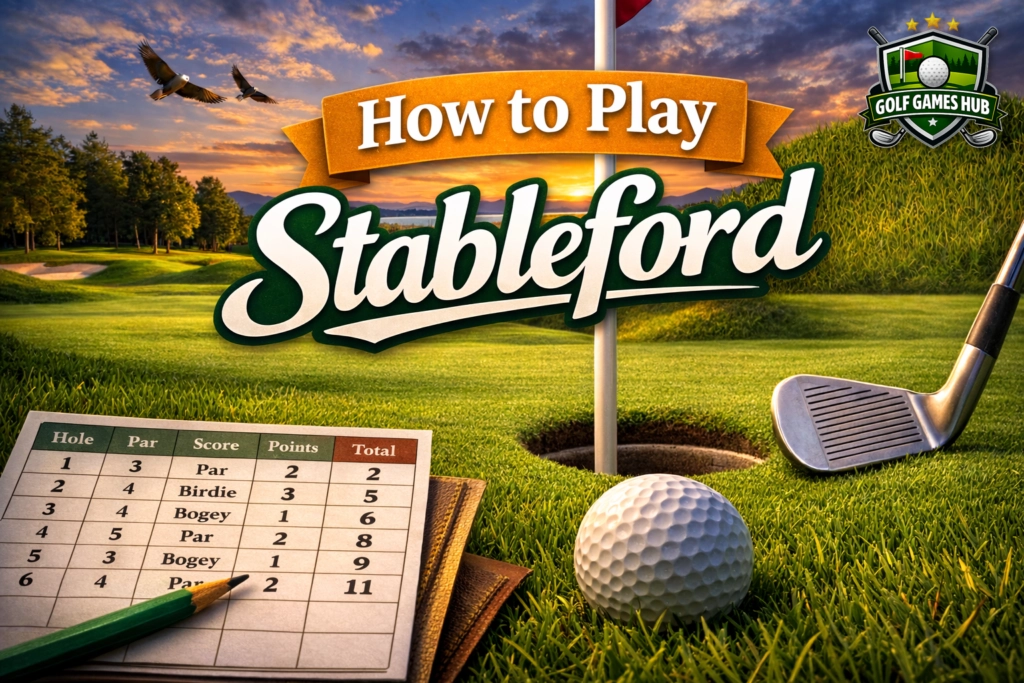
Standard points table for Stableford:
| Score | Points |
|---|---|
| Double bogey or worse | 0 |
| Bogey | 1 |
| Par | 2 |
| Birdie | 3 |
| Eagle | 4 |
| Albatross | 5 |
How to play each hole: Play it like normal stroke play, then convert your score to points using the table above.
Handicaps (if net): Apply your Course Handicap strokes on the hardest holes first (by stroke index). Then use your net score to determine your points.
Pace tip: If you can’t earn points anymore on a hole, pick up and take 0.
Winner: Add points for 18 holes—highest total wins.
If you want to fully understand how to play Stableford and learn some fun variations along with strategy to give you a leg up at the your favorite golf course, keep reading.
How to Play Stableford
Below is a breakdown of how to play the Stableford golf game.
Number of Players/Teams Required
Stableford is an individual form of stroke play and may be played with any size group.
Game Setup
Before play begins, the following needs to be determined:
- Determine the Scoring Method (for each hole). Common methods:
- Gross Stableford: Fixed target score equals par for the hole.
- Net Stableford: Fixed target score equals net par (par plus handicap strokes received on that hole).
- Decide on your Points Table. The standard scoring system most commonly used is:
- More than one over the fixed target (often double bogey or worse): 0 points
- One over (often bogey): 1 point
- Equal to target (often par): 2 points
- One under (often birdie): 3 points
- Two under (often eagle): 4 points
- Three under (often albatross/double eagle): 5 points
(You may adopt a different scoring system, if you prefer.)
Stableford Golf Game Rules
- Rules of Golf Apply as in Stroke Play
Play each hole under the standard Rules of Golf (stroke play). Count all strokes made and all penalty strokes. - How Points Are Awarded
After applying penalty strokes (and handicap strokes in a net competition), compare the player’s hole score with the fixed target score for that hole. Award points according to the points schedule. Points for a hole do not go below zero under the standard Stableford method. - Completion of a Hole and Picking Up
A hole is completed in Stableford when the player holes out, or reaches a score that will result in zero points under the scoring table. Players are encouraged to stop playing a hole when no points remain available, to help pace of play.

How to Keep Score in Stableford
In Stableford, it’s best to keep your score as you go and to log both strokes and points. This way when there is discrepancy, you have a record to refer back to.
- Record Hole Results
For each hole, determine the hole score achieved:- If the player holes out, record the actual strokes (including penalty strokes).
- If the player does not hole out because continuing cannot improve the result beyond zero points, record a hole result that would receive zero points for that hole under the scoring table.
- Apply Handicap Strokes for Net Stableford
If the competition is net:- Determine handicap strokes received on each hole (commonly by stroke index).
- Compute the player’s net score for the hole.
- Compare that net score to the fixed target score and award points accordingly.
- Convert to Points and Total
Convert each hole result to points using the scoring table chosen. Once the round is finished, total all your points for the round.
Scoring Examples (Standard Stableford Scoring, Fixed Target = Par)
- Example 1 (Gross, Par 4):
- Score 4 (par) → 2 points
- Score 3 (birdie) → 3 points
- Score 6 (double bogey) → 0 points
- Example 2 (Net, Fixed Target = Net Par):
Par 5, stroke index 2. Player receives 1 handicap stroke on the hole.- Fixed target = net par = 6 (par 5 + 1 stroke)
- Player shoots a 5 for the hole → this is one under the net target → 3 points
How to Determine Winner
At the end of the round, add each competitor’s Stableford points. The competitor with the highest total points is the winner. If the competition runs over multiple rounds, the winner is the competitor with the highest aggregate points across the stipulated rounds.
How to Handle Tie Breakers
Tie-breaking methods must be determined before play begins. Common methods include:
- Scorecard countback (for example: compare last 9 holes, if still tied, then last 6, then last 3, then last hole, using points).
- Hole-by-hole playoff using the same Stableford method and points table, if course access and timing permit.
- Matching on predefined holes (such as the most difficult holes by stroke index) using points.
Tips and Strategies for Stableford Golf Game
Stableford rewards outcome-based decision-making because the scoring converts each hole into points and caps the downside at zero points (under the standard table).
When to play aggressive
Take on higher-upside plays when a birdie or better is realistically available and the risk of a very poor score does not materially change the hole’s likely point outcome. Examples include attacking a reachable par 5 in two when a miss still leaves a straightforward up-and-down chance, or choosing a confident line on a short par 4 to set up a scoring wedge.
When to play safe
Prioritize securing 2 points (par relative to the fixed target) when conditions or position make higher outcomes unlikely. On difficult holes, a conservative target that produces a stress-free bogey can still preserve points in net competitions where the fixed target is net par.
Common mistakes
- Failing to apply handicap strokes correctly in net competitions, resulting in incorrect point totals.
- Continuing to play after the hole cannot produce points, which may be considered a waste of time by others.
- Treating Stableford like total-strokes stroke play and avoiding reasonable birdie chances that create the highest point swings.
Variations of Stableford
The following variations exist and can be considered when playing Stableford:
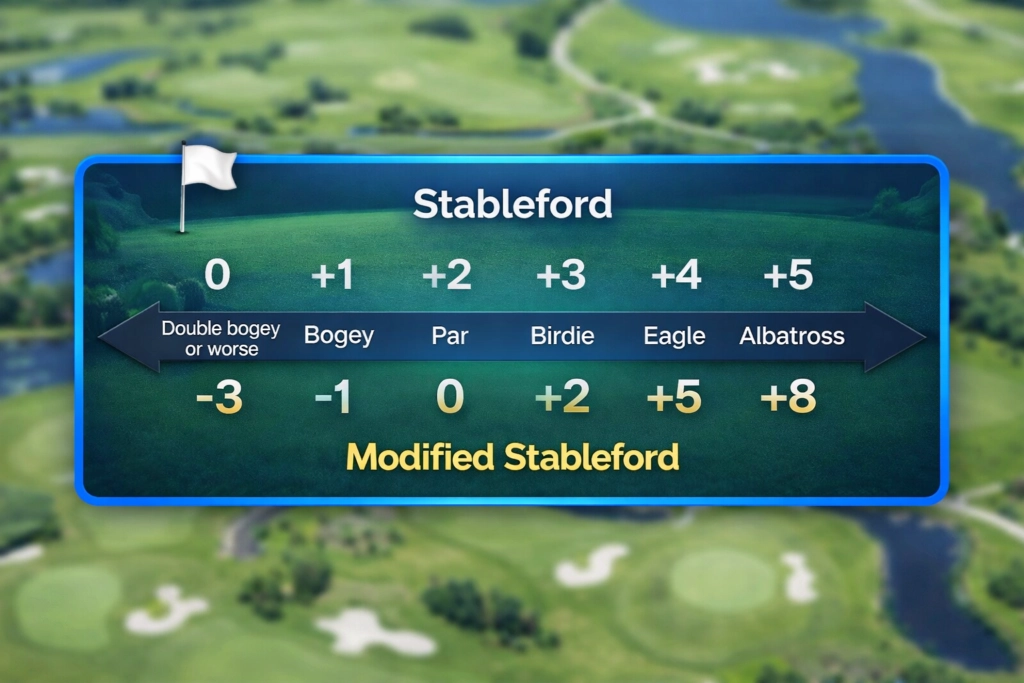
- Modified Stableford (Positive/Negative Points)
This variation awards larger positive points for under-par scores and assigns negative points for over-par scores. A widely used format is to assign the following points: albatross +8, eagle +5, birdie +2, par 0, bogey −1, double bogey or worse −3. Modified Stableford increases volatility and rewards aggressive play because a birdie can outweigh multiple bogeys. - Team Stableford
You can elect to play Stableford as teams by combining points (such as best-ball points per hole or a sum of both partners’ points).

FAQs About Stableford
Does Stableford work with handicaps?
Yes. Net Stableford is common because it sets a fixed target score that reflects handicap strokes allocated by hole. It’s common to use a player’s Course Handicap and allocate strokes by stroke index.
The player’s net score (gross score minus strokes received on that hole) determines the points for that hole. This method allows competitors of differing ability to compete on equal terms while still rewarding strong scoring holes.
Is Stableford for beginners?
Yes. Stableford supports beginners because it limits the damage of a single poor hole and permits picking up once no points remain available. That feature maintains pace and reduces pressure after mistakes while keeping the competition meaningful on every subsequent hole.
What does a “good” Stableford score look like?
This is all relative. But under the standard net Stableford method, 36 points generally reflects playing to the fixed target score across the round (commonly net par on every hole). Scores above 36 indicate performance better than target; scores below 36 indicate performance worse than target.
Final Thoughts on Stableford
Here at Golf Games Hub, we value Stableford because it keeps every hole relevant and keeps the round moving without weakening the traditional round of golf.
The format rewards smart scoring decisions, not just survival, and it gives players a clean way to recover after a bad hole by resetting the competition on the next tee.
Stableford also works exceptionally well in mixed-skill groups when played as net Stableford, because handicap strokes convert the fixed target into a fair standard for everyone.
For weekend rounds, leagues, and club events, Stableford delivers clear scoring, meaningful risk-reward choices, and a finish that stays competitive deep into the back nine.
Other Fun Golf Game Formats to Consider Besides Stableford
We know golf games here at Golf Games Hub. If you enjoy playing Stableford, you’re going to absolutely love playing these other golf game formats.
Chapman is a popular two-person team format that blends individual shot-making with teamwork and strategy. Both players hit a tee shot, then switch and play their partner’s ball for the second shot before choosing the best position and finishing the hole using alternate shots. The format creates constant decision-making and rewards strong teamwork, making it a favorite for tournaments and friendly competitions alike.
Bingo Bango Bongo turns every single hole into a three-part battle, rewarding precision, timing, and clutch putting in ways traditional stroke play can’t. Instead of only caring about total score, players compete for points throughout the hole — which means even higher-handicap golfers stay in the action from tee to cup. It’s fast, competitive, and surprisingly strategic.
Wolf is a high-pressure, rotating golf game where every hole forces one player to make a bold decision that can swing the entire round. It blends strategy, timing, and calculated risk in a way that keeps all four players fully engaged from the first tee to the final putt.



Leave a Reply