Learn how to play Sixes and you’ll learn one of golf’s most social foursome formats.
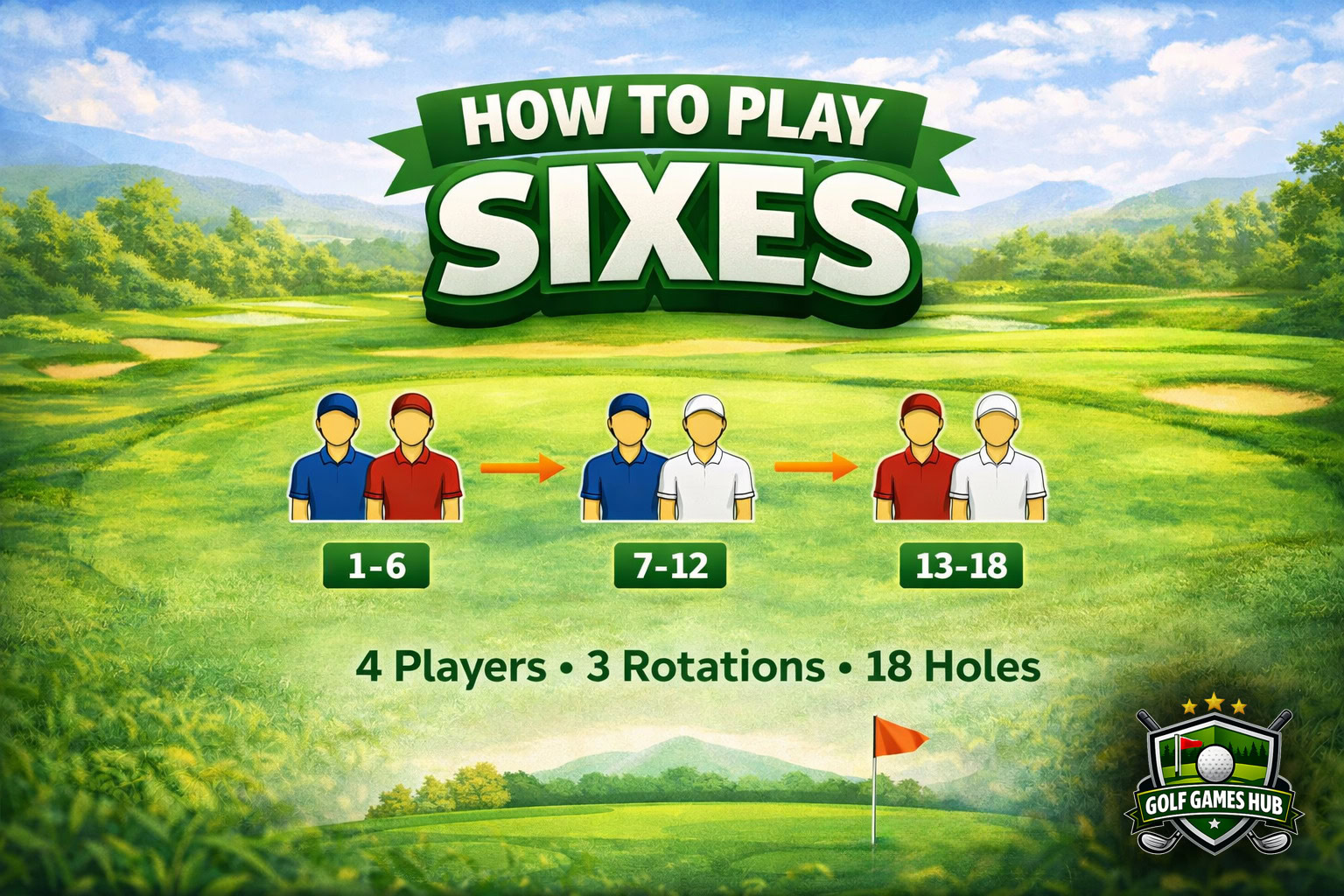
Sixes divides an 18-hole round into three separate six-hole matches. Partners rotate every six holes so that each golfer plays with (and against) every other golfer during the round.
This team-rotation structure keeps the competition fresh, spreads the pressure around, and prevents one bad stretch from deciding the entire day too early.
The sections below set out the standard version first, then explain the setup, scoring, tie procedures, strategy, and the most common variations so the game can be customized and played to your liking.

MORE TEAM GAMES TO CHECK OUT


Get the Sixes scorecard
$2.99
Instant PDF download · Print at home · Yours forever
Quick Summary / TL;DR
Sixes (aka Hollywood or Round Robin) is a four-player golf game played over 18 holes in three six-hole segments. In the standard version, players form two sides for holes 1 through 6, change partners for holes 7 through 12, and change again for holes 13 through 18. A common rotation is:
- Holes 1–6: A and B vs. C and D
- Holes 7–12: A and C vs. B and D
- Holes 13–18: A and D vs. B and C
Each player plays their own ball throughout the hole. The team score is the lower score of the two partners on that hole. Most groups play each six-hole segment as its own match.
A team wins a hole by posting the lower better-ball score, halves the hole if there is a tie, and wins the six-hole segment by winning more holes than the other side.
Before the round starts, the group should agree on the exact scoring format, whether handicaps apply, how tied six-hole segments will be treated, and whether the day winner will be the player who wins two of the three segments or whether each segment stands as a separate result.
These details matter because the name “Sixes” is used for more than one golf format.
The full guide below explains the most-standard version, then covers the most used variations, tie policies, and strategy pointers to give you a leg up on the competition.
How to Play Sixes Golf Game
The standard form of Sixes requires exactly four players. That requirement is central to the structure of the game.
The rotation nature of Sixes only works properly when each golfer can partner with each of the other three golfers once in the round.
The round is played over 18 holes, but it is treated as three separate six-hole segments:
- Segment 1 – Holes 1 thru 6
- Segment 2 – Holes 7 thru 12
- Segment 3 – Holes 13 thru 18
This rotation creates the core appeal of the game. No player stays with the same partner all day, and no player faces the same pairing all day. A golfer who struggles in the opening segment still has two fresh chances with two different partners.
The cleanest and most widely accepted way to run Sixes is as four-ball match play.
In four-ball match play Sixes, every player plays his or her own ball for the entire hole. At the end of the hole, each team takes the lower of their two scores for the hole. The team with the lower score wins the hole. If both teams have the same better-ball score, the hole is halved.
Example Hole:
Team 1: Player A makes 5, Player B makes 4
Team 2: Player C makes 4, and Player D makes 6.
Team 1 records 4 as its better-ball score because that is the lower of A’s and B’s scores. Team 2 also records 4 because that is the lower of C’s and D’s scores. Thus, the hole is halved.
Example Segment 1 (Holes 1 thru 6):
- Team 1 wins holes 1 and 4
- Team 2 wins hole 5
- Holes 2, 3, and 6 are tied.
- Team 1 wins Segment 1, as they finished the segment “1 up”.
The same procedure then starts fresh for holes 7 through 12 with the new partners, and again for holes 13 through 18.

Sixes Golf Game Setup
Before the first tee shot, the group should settle five items:
- Confirm the variant. State clearly that the round is rotating-partner Sixes.
- Set the pairing rotation. Use the standard rotation unless everyone agrees otherwise.
- Choose the scoring method. The recommended default is net or gross four-ball match play.
- Decide handicap treatment. If handicaps are used, apply the handicap method that matches the underlying format.
- Agree on tie handling and settlement. Decide whether tied six-hole segments are pushes, half-points, or subject to a playoff or other tiebreak.
- Decide how a winner will be determined. This is where variance comes into play in Sixes. I will explain how to determine a winner later in this post.
This pre-round checklist prevents the most common dispute in Sixes, which is not a rules issue during play but a misunderstanding before play.
How to Keep Score in Sixes
The scorecard should show three things at all times: the current partners, the hole result, and the segment standing. A practical layout is to mark holes 1 through 6 as the front segment, holes 7 through 12 as the middle segment, and holes 13 through 18 as the final segment.
For each hole in the standard format:
- Record all four gross scores.
- Apply handicap strokes if the group is using net scoring.
- Determine each side’s better-ball score.
- Mark the result as Team 1 win, Team 2 win, or halved.
At the end of hole 6 and hole 12, close out the segment before moving on. That moment is also the right time to confirm new partners, recalculate any stroke allocations that depend on the matchup, and make sure every player understands the current standings.
A sample first segment might look like this (no handicaps used):

In that example, A-B wins three holes, C-D wins one, and two holes are halved. A-B wins the segment.
How to Determine the Winner
Sixes is played in more than one settlement style, so the winner must be defined before the round begins. The three most common methods are these:
- Each six-hole segment stands alone. This is the simplest method. Each segment is its own match or wager. A player may win one segment, halve one, and lose one. This method works especially well in casual money games.
- Best two of three segments. Under this method, the overall winner is the golfer who finishes on the winning side in at least two of the three six-hole segments. This is one of the most commonly described “overall winner of the day” methods.
- Points or dots across the round. Some groups award a point or “dot” to each player on the side that wins a hole or wins a segment. The day winner is the player with the most accumulated points.
It’s up to the group to determine which method to use to determine the winner.
How to Handle Handicaps
Sixes does not have a unique handicap system of its own. The best practice is to use the handicap method that matches the scoring format being used underneath.
In standard four-ball match play , it’s common to use a handicap allowance, often 90 percent, then allocating strokes by stroke index after setting the lowest handicap player to scratch.
In four-ball stroke play style scoring, a different allowance may apply.
The important point is consistency: choose the method before play starts and use it the same way in all three segments unless the group expressly adopts a segment-by-segment variation.
How to Handle Tie Breakers
Tie handling in Sixes must be simple and explicit. The best default procedures are:
- A tied hole is halved.
- A tied six-hole segment is a push.
- If the group is using day points, a tied segment may also be worth one-half point to each side.
That structure fits the match-play character of the game and avoids forcing artificial tie-break procedures into a casual format. If the group wants a single overall winner with no ties, it may adopt a pre-announced tiebreak such as:
- Sudden-death playoff hole, or
- Nearest-to-the-pin contest after the round.
One additional house rule appears in some Sixes variations: if the better-ball scores tie on a hole, compare the second ball from each side to break the tie. That is a valid local variation, but it is not the standard rule and should be declared before the round begins.


Every scorecard.
Built for every format.
- Download them. Print them. Take them to the course.
- Dedicated layouts specific to each game.
- Buy once. Print forever. All future cards included.
$9.99
★Card generator included. Add your course’s yardages, pars, and handicaps.
Pace of Play and Etiquette in Sixes
The rotating structure adds a small amount of administration, so the group should manage that process actively. Standard on-course etiquette still applies — maybe even more here, since you’re changing partners twice mid-round.
Keep the checkpoint at hole 6 and hole 12 brief. Confirm the result, confirm the next partnerships, and move on.
In a match-play version, concessions should be clear and consistent. In any version, players should be ready to play, move efficiently, and avoid turning scoring discussions into delays.
Sixes works best when the format adds energy without adding clutter.
Tips and Strategies for Sixes
The strategy in Sixes changes with the state of each hole and the fact that partners change twice during the round. That is what gives the game its depth.
Play aggressively when… the opposing team has made birdie or has one player in excellent position, a conservative line may not be enough. In those moments, the trailing team should let the player in weaker position play first when practical, allowing the other partner to attack with more freedom.
Play safely when the other team is in trouble. If both opponents are out of position, the percentage play usually becomes the correct play. A ball in play and a likely par often wins more holes in Sixes than a risky attempt at something better.
Avoid the most common mistake in the format: forgetting that one bad hole only costs one hole. Players often force an unnecessary hero shot after a poor tee ball even though a solid bogey may still halve the hole or keep pressure on the other side.
Another common mistake… treating every partner the same way. Sixes rewards adaptability. With one partner, the smart play may be steady support. With another, the smart play may be taking on more risk because that partner reliably produces pars. The best Sixes players read the matchup, not just the yardage.
Variations of Sixes
Sixes has several legitimate variations, but they should be understood as variations, and not the standard game.
The first and most common variation keeps the same rotating-partner structure but changes the scoring method. Instead of four-ball match play, a group may use net better-ball Stableford, aggregate side scoring, or a points-per-hole system. These options work well when the players have mixed skill levels or when the group wants a format that softens the effect of one blow-up hole.
Another variation uses dots or money presses within each six-hole segment. For example, the front three and back three of a six-hole segment can be treated as mini-contests inside the segment. That adds betting structure without changing the rotation.
A different game altogether is often confused with Sixes: “6-6-6” where the format changes every six holes, such as alternate shot for six holes, scramble for six holes, and best ball for six holes. That is a valid format, but it is not the standard rotating-partner version covered in this guide.

FAQs About Sixes Golf Game
This final section answers the questions that most often come up when playing Sixes.
What Is The Difference Between Sixes and 6-6-6?
Sixes and 6-6-6 are both structured around six-hole segments, but they differ in what actually changes during the round. In Sixes, the format stays the same (typically 2 vs. 2 match play), but partners rotate every six holes, so each player teams up with every other player once. In contrast, 6-6-6 keeps the same teams throughout the round, but changes the format every six holes (for example, scramble, then best ball, then alternate shot). In short, Sixes changes partners, while 6-6-6 changes the game format.
Can Sixes be played with three players?
Not in its standard rotating-partner form. The usual Sixes format assumes four golfers so that every player can partner with each of the other three golfers once. If you’re looking for threesome-only formats, see our 3-player golf games roundup.
Can Sixes be played with more than four players?
Not as the classic version. Larger groups can run events built around six-hole segments, but those are modified event formats rather than standard recreational Sixes.
Is Sixes match play or stroke play?
Most often, it is played as four-ball match play. However, many groups use other scoring methods, including Stableford or stroke-based side scoring, so long as the method is agreed before the round.
What is the fairest way to score Sixes?
For most groups, net four-ball match play is the fairest and simplest because every player stays involved, handicaps can be applied cleanly, and the hole-by-hole match structure fits the rotating partnerships.
What happens if a six-hole segment is tied?
The best default is to treat the segment as a push or award each side one-half point if the group is using points.
Does Sixes play faster or slower than a normal round?
It can do either. The game tends to stay lively because each six-hole segment matters, but it slows down if the group spends too much time discussing calculations, bets, or rotations. A clean scorecard and fast checkpoint at holes 6 and 12 solve most of that problem.

Final Thoughts on Sixes
Here at Golf Games Hub, we like Sixes because it combines structure, variety, and fairness in a way very few golf games can match.
The partner rotation keeps the round from getting stale, the six-hole segments keep every stretch of the round relevant, and the better-ball framework gives every player repeated chances to help the side.
Most importantly, Sixes gives the round a steady rhythm without making it overly complicated. That balance is what makes it one of the strongest formats for a competitive and social foursome.
Other Fun Golf Game Formats to Consider
If you enjoy the rotating partnerships and strategic shifts in Sixes, there are plenty of other formats worth mixing into your regular group.
For more strategy-driven competition, explore our Traditional Golf Games Collection. If you’re looking for formats that keep things lively and interactive from start to finish, our Fun & Social Golf Games Collection is a great place to start.
Of course, we also have a dedicated Collection of Betting Formats, if you want to up the ante.
Below are a few of our hand-selected favorite golf games to try on your next round.
- Quota is a points-based format where each player is assigned a target score based on their handicap. Points are earned on each hole depending on performance relative to par, and the goal is to meet or exceed your quota by the end of the round. Because everyone is playing against their own benchmark, Quota creates balanced competition and keeps every player engaged.
- Vegas is a high-stakes team game that pairs two-player teams and combines scores into a two-digit number on each hole (like a 4 and 5 becoming 45). The lower combined number wins the hole, often for a set dollar value. With scores stacking quickly, Vegas adds volatility, pressure, and the potential for big swings throughout the round.
- Nassau divides the round into three separate matches: the front nine, the back nine, and the overall score. This structure keeps players in contention even after a slow start, since each segment is its own contest. With simple scoring and multiple chances to win, Nassau remains one of the most reliable and widely played formats.
- Chapman is a two-player team format that blends individual execution with teamwork. Both players tee off, switch balls for the second shot, then choose the best position from there and alternate shots until the hole is finished. The format rewards smart decision-making and strong communication, especially when playing to each partner’s strengths.