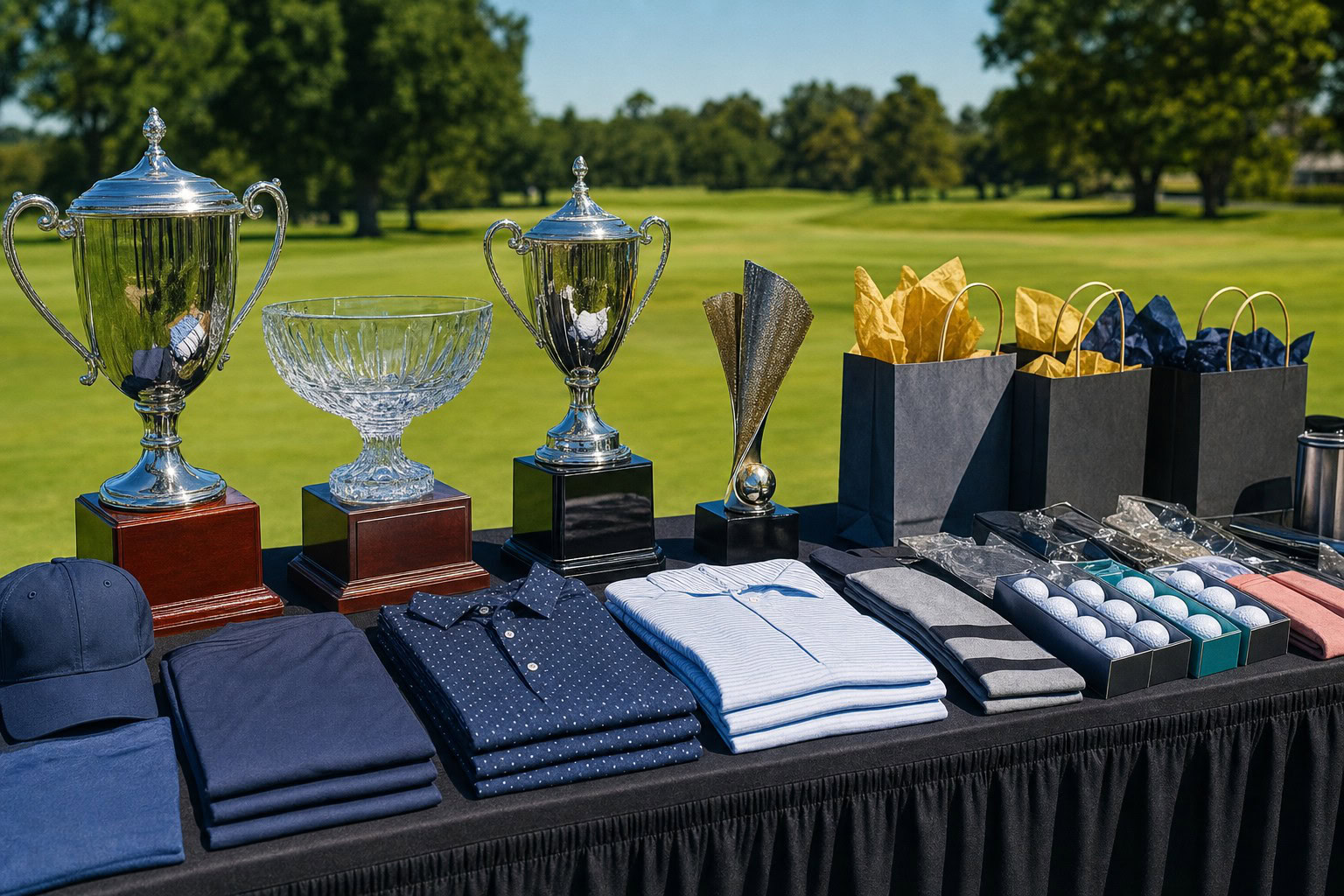
Good golf tournament prizes and awards do two jobs at once: they give every player a reason to care about their score, and they send people home talking about your event.
For a charity scramble, a company outing, a member-guest, or a buddy trip, the prize table is not an afterthought. It is part of the experience, and a little structure goes a long way toward making it feel fair, fun, and worth coming back for next year.
This guide covers how to structure your awards so the same team does not sweep everything. It also showcases the best prize ideas by category and budget, including the fun novelty awards that set the mood.
If you are still mapping out the wider day, start with our guide to running a charity golf tournament and use this as the deep dive on prizes.
Some links in this post are affiliate links. If you buy through them, we may earn a small commission at no extra cost to you.
How to Structure Your Tournament Awards

Picking out the prizes is relatively easy. The harder part is deciding who wins what, because a poorly designed award structure either rewards the same low handicappers every time or leaves your better players feeling like skill does not matter. The fix is to award on more than one axis.
Low Gross vs Low Net
Low gross rewards the lowest actual score, no handicap applied. It honors raw skill, and it almost always goes to your scratch and single-digit players. Low net subtracts each player's or team's handicap from their score, which levels the field and gives a 20-handicapper a genuine shot at winning. Award both. Low gross keeps the strong players engaged, and low net keeps everyone else in the hunt until the last hole.
One simple rule prevents hurt feelings: a team or player should win either gross or net, not both. If your low gross winner also posts the low net, slide the net award down to the next eligible team. That single move spreads the prizes around and quietly solves the "same team wins everything" problem.
Awarding by Flight
A flight is a smaller competition inside the bigger one. You split the field into groups of similar ability, usually by handicap, and award winners within each flight. A field of 30 teams might run three flights of ten, each with its own first and second place. The payoff is huge: a mid-pack team is no longer competing against the ringers, so more of your players finish the day feeling like they were actually in it. Flighting is the single most effective tool for making a broad field feel competitive.
How Many Places to Pay
For a typical charity scramble, paying the top two or three teams per flight hits the sweet spot. Pay too few and the day feels winner-take-all. Pay too deep and the prizes get thin and lose their shine. A clean default looks like this: low gross overall, low net per flight (top 2-3), plus a handful of contest and novelty awards so the recognition reaches well beyond the leaderboard. As a rule of thumb, aim for somewhere around one in four or one in five players to walk away with something, counting tee gifts and door prizes.
Team vs Individual Awards
Scrambles and best-ball events are team formats, so your main awards go to the winning team. Make sure the prize can be split four ways: four gift cards beat one big item that only one player can take home. Individual awards still have a place through the on-course contests and the novelty categories, which is where solo players get their moment. We cover the contest side in full in our guide to on-course contest ideas, so here we just slot them into the award lineup.
Quick Reference: A Sample Award Lineup
Here is a clean, balanced set of awards for a charity scramble. Adapt the prizes to your budget, but keep the spread of categories so recognition lands on different people.
| Award | Who wins it | Typical prize |
|---|---|---|
| Low Gross (Overall) | Lowest actual team score | Trophy plus pro-shop credit |
| Low Net (Overall) | Lowest handicap-adjusted score | Gift cards split among the team |
| Low Net by Flight | Best net team in each skill group | Golf gear or restaurant gift cards |
| Closest to the Pin | Nearest the cup on a chosen par 3 | Box of premium balls or a rangefinder |
| Longest Drive | Longest drive on a marked fairway | Driver headcover or pro-shop voucher |
| Team Champions | Tournament-winning foursome | Engraved trophy plus apparel |
| Last Place / Most Honest | Highest honest team score | Novelty trophy and a fun gag gift |
| Best Dressed or Best Cart | Most committed to the theme | Themed basket or gift card |
| Hole-in-One | Any ace on the designated hole | Sponsored grand prize (car, trip, cash) |
Prize Ideas by Category

The best prize tables mix a few marquee items people genuinely want with a deeper bench of useful, on-brand gear. Here is how to build that range.
Golf Apparel and Gear
This is the safe, always-appreciated core. Think quarter-zip pullovers, rain jackets, caps, golf gloves, premium golf balls, and divot tools. A logoed polo or a dozen good balls feels like a real reward and still fits a modest budget. Gear that carries a sponsor or charity logo doubles as marketing every time the winner wears it.
Pro-Shop Credit and Gift Cards
Pro-shop credit is the workhorse award: easy to source from the host course, flexible for the winner, and (as you will see below) clean under the amateur rules. Restaurant, retail, and rideshare gift cards round out the table nicely. A "night out" bundle of a restaurant card, a rideshare card, and event tickets is an easy crowd favorite.
Experiences and Travel
For a standout award, lean into experiences: a golf getaway, a foursome at a bucket-list course, a resort stay, a spa day, or VIP tickets to a local game or concert. Experiences photograph well, build buzz before the event, and often cost you nothing when a sponsor donates them.
Electronics
Golfers love gadgets. A laser rangefinder, a GPS watch, a launch monitor, wireless earbuds, or a portable speaker all make excellent mid-to-high-tier prizes. The GPS watch we recommend comes with 42,000 courses preloaded, and a quality Bluetooth speaker can sit on the prize table for under $100. A rangefinder in particular is a perfect closest-to-the-pin reward because it ties straight back to the skill being tested.
Premium and Grand Prizes
Every event benefits from one or two marquee prizes that anchor the day. A new driver, a full set of irons, a big travel package, or the classic hole-in-one prize (a car, a large cash payout, or a trip) gives players something to dream about on the tee. Hole-in-one prizes are almost always covered by a prize-indemnity sponsor (via hone-in-one insurance) for a flat fee, so the upside is huge and your downside is capped.
Tee Gifts and Gift Bags for Every Player
Do not forget the tee gift, the small bag every player gets just for showing up. A sleeve of balls, a logoed towel, a hat, tees, a snack, and a sponsor flyer make a respectable bag. It sets the tone the moment players check in and ensures nobody leaves empty-handed. Order these early; they are easy to forget in the rush, so add them to your golf tournament planning checklist well ahead of the date.
Fun and Novelty Awards That Boost the Vibe

Serious awards reward the few. Novelty awards reward the mood of the whole room. They give the players who shot 110 a reason to laugh instead of slink off, and they turn the ceremony into entertainment rather than a results readout. A handful of well-chosen gag awards is the cheapest way to make an event feel memorable.
- Most Honest Golfer: the gentle, friendly name for the highest score of the day.
- Biggest Blow-Up: for the most spectacular single-hole meltdown, paired with a sleeve of balls.
- Best Dressed: for the loudest, proudest outfit on the course.
- Best Decorated Cart: for the foursome that turned their cart into a parade float.
- Most Lost Balls (The Mulligan Award): won with new golf balls, naturally.
- Sand Specialist: a toy bucket and shovel for the player who never left the bunkers.
- Closest to the Beer Cart: a lighthearted nod to whoever enjoyed the day most.
Keep them good-natured. The goal is shared laughter, not embarrassment, so read the room and skip anything that singles a person out in a mean way.
Trophies and Keepsake Awards

A gift card gets spent and forgotten. A trophy sits on a desk for years. For your headline categories (team champions, low gross, low net), pair the prize with something engraved: a cup, a glass award, a plaque, or an engraved golf ball on a stand. The cost is small and the keepsake value is what people remember.
Novelty trophies deserve the same treatment in reverse. A deliberately tacky trophy for the most honest golfer or the biggest blow-up becomes a running joke that the "winner" is weirdly proud to have earned. If your event runs every year, consider a perpetual trophy for the overall champions, engraved with each year's winner, to build a little tradition.
Amateur-Status Rules Organizers Must Not Break

This is the part almost organizers often ignore, and it is the part that can actually cause a problem. Be aware that some of your participants may be amateurs, seeking pro status eventually. The Rules of Amateur Status (governed by the USGA and The R&A, modernized effective 2022) limit what an amateur can accept without jeopardizing their status. A few simple guardrails keep your players and your event clean.
- An amateur may accept prizes up to a value of US$1,000 per competition. Keep individual award values under that line.
- Cash and prize money are only allowed in a scratch competition (no handicaps), and still only up to the $1,000 limit.
- In a handicap competition, which describes almost every charity scramble, an amateur cannot accept cash or prize money at all. Non-cash prizes up to $1,000 are fine.
- Gift cards and vouchers that can be redeemed for cash or used to withdraw cash count as prize money, so they carry the same restriction as cash. Plain pro-shop credit and retail gift cards for goods and services are treated as non-cash prizes and are safe.
- The hole-in-one exception: prize limits do not apply to a prize for an ace. A player can win a car or a big cash prize for a hole-in-one (the shot must be at least 50 yards if it happens during the round).
The practical takeaway is simple. For your handicap event, award merchandise, gear, experiences, and pro-shop credit rather than cash, keep each prize comfortably under $1,000, and save the big-money payouts for the hole-in-one, where the rules give you a clear exception. Do that and no winner has to choose between your prize and their amateur status.
A Quick Word on Prize Budgets
For a fundraiser, prizes are a cost, so keep them in proportion. A common guideline is to spend roughly 10 to 15 percent of your gross revenue on prizes and player gifts combined, scaling up for higher entry fees and down for lower ones. The number matters less than the principle: prizes should enhance the day, not eat the cause.
The smartest move is to make most of your prizes donated or sponsored. Local businesses, the host course, and your sponsors will often supply gift cards, gear, experiences, and grand prizes in exchange for recognition, which stretches your budget while keeping your out-of-pocket cost near zero. Note that the on-course contest prizes and the raffle or auction items are separate line items. We cover the money-raising side in our guide to golf tournament fundraising ideas, including silent and live auctions.
Running the Awards Ceremony

Timing is everything. Hold the ceremony after the round, during the meal or reception, when players are seated, fed, and relaxed. Trying to do it before food, or while half the field is still on the course, kills the energy fast.
Keep it short and brisk. Aim for fifteen minutes or less. Lead with a quick thank-you to sponsors (this is the moment they paid for), then move fast: team champions, low gross, low net by flight, the contest winners, and finish on the novelty awards so the room ends on a laugh. Have the prizes staged and the names ready so there are no awkward pauses.
A few details lift the whole thing: announce the result, whether that is the amount raised or the champions, snap photos of every winner, and recognize your volunteers and committee. People remember how the day ended, and a tight, generous ceremony is what brings them back next year.
Putting Your Prize Plan Together

Strong prizes are not about spending the most. They are about structure and spread: award low gross and low net, flight the field, pay two or three deep, and layer in contests and novelty awards so recognition reaches far beyond the winners' table.
Lock the amateur-status rules in mind, keep individual prizes under $1,000, lean on donated and sponsored items, and save the big money for the hole-in-one.
Do that, and your awards ceremony becomes the high note of the day instead of a footnote. Players leave happy, sponsors feel seen, your cause comes out ahead, and your event earns the kind of word of mouth that fills the field again next year.