


Chapman blends elements of scramble, alternate shot, and best ball, creating a format that rewards both teamwork and smart decision-making.
This post outlines the rules and scoring for the Chapman golf game.
Chapman—sometimes called the Pinehurst format—is played with four golfers divided into two teams of two.
What makes the format unique is that both partners hit drives, then switch and play each other’s ball for the second shot before selecting the best shot to continue the hole.
From there, the team alternates shots until the ball is holed out.
Chapman is popular in club tournaments, charity events, and friendly matches because it rewards both strong driving and solid approach play. It also produces dramatic momentum swings, making the game competitive and entertaining from the first tee to the final putt.
This guide explains the rules for playing Chapman along wth how to handle scoring with and without handicaps.
Why Chapman Is Sometimes Called Pinehurst
Chapman is widely known as the Pinehurst Format because it was popularized at Pinehurst Resort tournaments. The two names refer to the same format, though some events slightly modify the rules regarding which player hits the third shot.
Understanding that both names describe essentially the same game prevents confusion when entering tournaments or reading event rules.

The Key Rules of Champan Golf
The following rules define how to play Chapman. These rules mirror the structure typically used in official golf competitions.
Setting Up the Game of Chapman
Chapman is played with teams of two golfers competing against another two-person team.
Before the round begins:
- Players form two-person teams.
- Determine how your round will be played. Will you use standard stroke play scoring (where total strokes determines the winner) or match play scoring (where teams compete to win individual holes)?
- Flip a coin or spin a tee to see which team tees off first.
How Chapman Golf Scoring Works
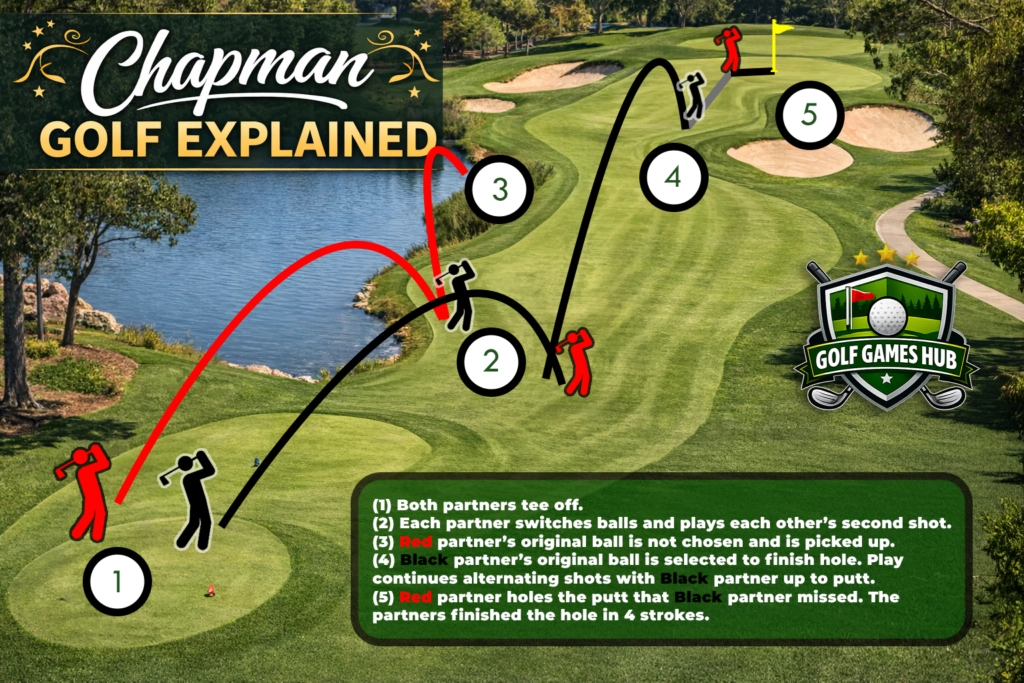
The sequence of play for each hole follows a strict four-step process.
Step 1 – Both Players Hit Tee Shots
Each partner hits a drive from the tee box.
The team now has two balls in play located somewhere on the hole.
Example:
- Player A hits a drive to the fairway.
- Player B hits a drive into the rough.
Both balls remain in play.
Step 2 – Players Switch Balls for the Second Shot
For the second shot, each partner must play the other player’s ball.
Continuing our example, this means:
- Player A hits the second shot from Player B’s drive that is in the rough.
- Player B hits the second shot from Player A’s drive that is in the fairway.
After these shots are played, the team now has two balls again, each in a new location.
Step 3 – The Team Chooses One Ball to Finish the Hole With
After both second shots are completed, the team evaluates the results and chooses one ball to continue playing.
The other ball is picked up and removed from play.
Example:
- Ball 1 is now 120 yards from the green.
- Ball 2 is just short of the green.
The team chooses Ball 2 because it is closer to the hole.

Tip: Ball selection after the second shot often determines the outcome of the hole.
Smart teams evaluate:
- Distance remaining to the hole
- Angle into the green
- Obstacles (trees, bunkers, water)
- Lie quality (fairway vs rough vs bunker)
- Which partner will hit the next shot – this is a HUGE factor to consider.
Sometimes the closer ball is not the best option if it leaves the weaker partner with a difficult approach or putt.
Step 4 – Alternate Shots Until the Ball is Holed
Once the team selects the ball to continue, the players finish the hole using alternate shot.
The partner whose second shot was NOT selected plays the next shot for the team.
Players then continue alternating shots until the ball is holed.
Applying Handicaps in Chapman
If you have golfers of vastly differing abilities, it’s best to apply handicaps to make the round more fun and fair for everyone.
When handicaps are used in Chapman, teams typically receive a combined team handicap allowance. A common method is:
- Each player uses their course handicap.
- The two teammates combine 60% of the lower handicap and 40% of the higher handicap to determine the team handicap.
Example for Team 1:
| Player | Course Handicap |
| Player A | 8 |
| Player B | 18 |
Team handicap calculation:
- 60% of 8 = 4.8
- 40% of 18 = 7.2
Team 1 handicap = 12 strokes
Assume that Team 2’s handicap came out to be 8 strokes.
In this case, Team 1 would receive 12-8 = 4 strokes for the round.
Those strokes are then applied to the holes according to the course handicap ranking. Check out this link for more information on how to handle handicaps.
How to Determine the Winner in Chapman
The winning team depends on the scoring format chosen before the round.
Stroke Play Chapman
In stroke play Chapman:
- Each team records the total number of strokes taken on each hole.
- The team with the lowest total score after 18 holes wins the match.
Match Play Chapman
Chapman is also commonly played as match play.
In match play:
- Teams compete to win individual holes.
- The team with the lower score on a hole wins that hole.
- The match ends when one team leads by more holes than remain.
Why Chapman Is More Balanced Than a Scramble
Many golfers prefer Chapman over scramble formats because it requires equal contribution from both partners.
In a scramble:
- One strong player can carry the team.
In Chapman:
- Both players must execute shots throughout the hole.
- Alternating shots adds pressure and teamwork.
This balance makes Chapman ideal for competitive club events and friendly matches where fairness matters.

Other Considerations for Chapman
Chapman is relatively simple once you understand the basics. However, many groups also introduce variations such as modified ball-selection rules, or scoring twists that change how aggressive teams play the hole.
For a full breakdown of those variations, along with strategic tips and advanced tactics for winning Chapman matches, visit our complete Chapman Golf Games Guide. That guide covers every nuance of the format and helps players understand how to maximize their team performance.
That’s it for rules & scoring explained for the Chapman golf game.
If you enjoy playing Chapman, or if you’re looking for a different format, check out a few of our other favorite golf games!
Other Fun Golf Game Formats to Consider
Bingo Bango Bongo turns every hole into a three-part contest that rewards smart positioning, timely execution, and clutch putting in ways traditional stroke play simply doesn’t. Instead of focusing only on total score, players battle for points at multiple moments during the hole. That structure keeps everyone involved from the first shot to the final putt, even if someone hits a bad drive. The result is a format that feels fast, competitive, and extremely fun.
Wolf is a high-pressure rotating format where one player on each hole must decide whether to play alone or recruit a partner. That single decision can completely shift the stakes of the hole and even the entire match. The game blends timing, strategy, and calculated risk in a way that keeps all four players engaged and constantly thinking ahead from the opening tee shot to the final green.
Stableford flips traditional golf scoring on its head by rewarding positive play instead of heavily punishing mistakes. Players earn points based on their performance on each hole, which means a bad hole doesn’t automatically derail the entire round. Because of this scoring structure, golfers can stay aggressive, recover quickly, and play at a faster pace. It’s competitive, momentum-driven, and widely used in tournaments around the world.
Vegas is an action-packed team betting format where two teams of two combine their scores into a two-digit number — for example, a 4 and a 5 become 45. The lower number wins the hole, and the difference between the two numbers determines the payout. Because the scoring compounds rapidly, one rough hole can swing the entire match. That volatility is exactly what makes Vegas one of the most exciting and talked-about betting games in golf.




Leave a Reply