


If you’re trying to figure out how to play the Chapman Golf Game (also commonly called Pinehurst), then you’ve come to the right place.
So, how do you play Chapman?
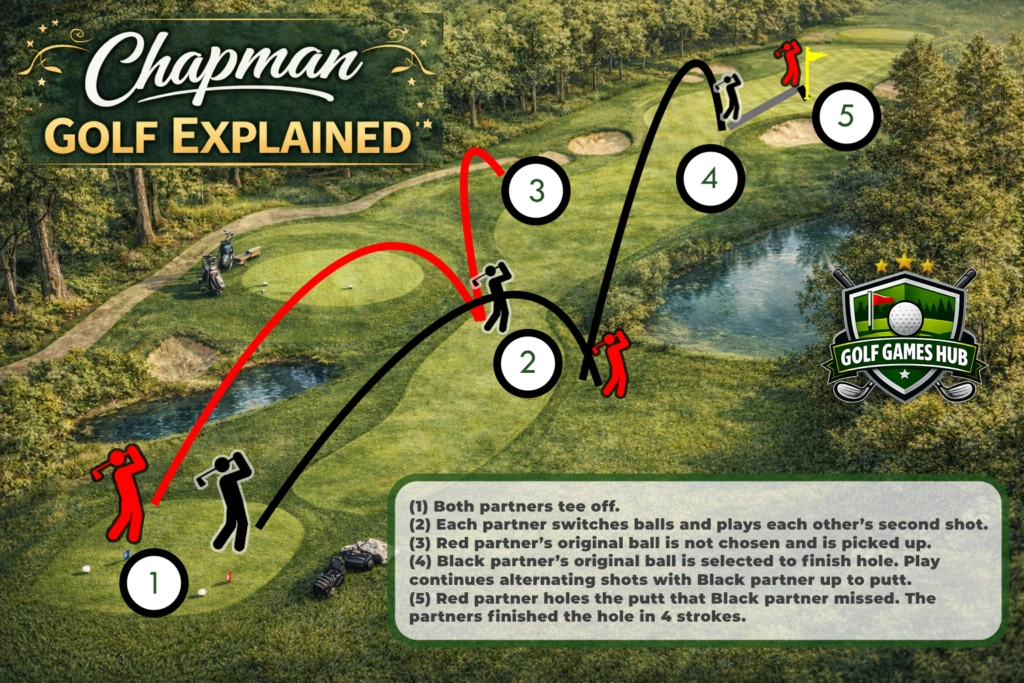
Chapman is a two-player team golf format that blends elements of best ball and alternate shot. Each partner tees off, then the partners switch balls and play each other’s tee shot for the second stroke.
The team then selects the better-positioned ball after those second strokes and completes the hole by playing that chosen ball in alternating order until it is finally holed out.
This structure rewards smart teamwork: it values two solid opening shots, a sound selection decision after two strokes, and disciplined execution under alternate-shot pressure.
The sections below provide the complete rules for playing Chapman, how to handle scoring, handicap guidance, tie-break options, and common variations to really amp up the fun.
Quick Summary/TLDR
To play a round of the Chapman golf game, form teams of two.
On every hole, both partners play a tee shot with their own ball. After both drives, the partners switch balls: Player A plays Player B’s ball for the second stroke, and Player B plays Player A’s ball for the second stroke.
After both second strokes, the team compares the two balls and chooses one ball to continue with; the other ball is lifted and is out of play. From that point forward on the hole, the team plays alternate shot with the chosen ball until it is holed.
The player whose second stroke was not used plays the third stroke, and the partners continue alternating thereafter.
The team’s score for the hole equals the total strokes (plus any penalty strokes) taken with the chosen ball.
Chapman may be run as stroke play (lowest total team score wins) or match play (each hole won, lost, or tied).
Continue reading for the full rules of Chapman, handicap application, recommended tactics to beat your competition, and popular variations of Chapman.
How to Play Chapman
Below is a breakdown of how to play the Chapman golf game.
Number of players/teams required
- In Chapman, you form any number of teams. But what is absolutely required is 2 players per team. Chapman works great for a foursome.
- If you have a large group, you can play with multiple 2 player teams and count point totals all playing against one another. Or, split the large group down the middle (creating multiple pairs of 2 on each team) and team up Ryder Cup style.
Game Setup
- Form your teams of two players.
- Establish the format before play begins:
- Stroke play (gross or net) for a field of teams, or
- Match play (gross or net) between two teams.
- Set the Terms of the Competition:
- Which tee markers must be used, how long will the round be (9 or 18 holes), and whether play runs as gross or net (using handicaps).
- If net: confirm everyone’s handicap score and apply strokes on the appropriate holes, if required.
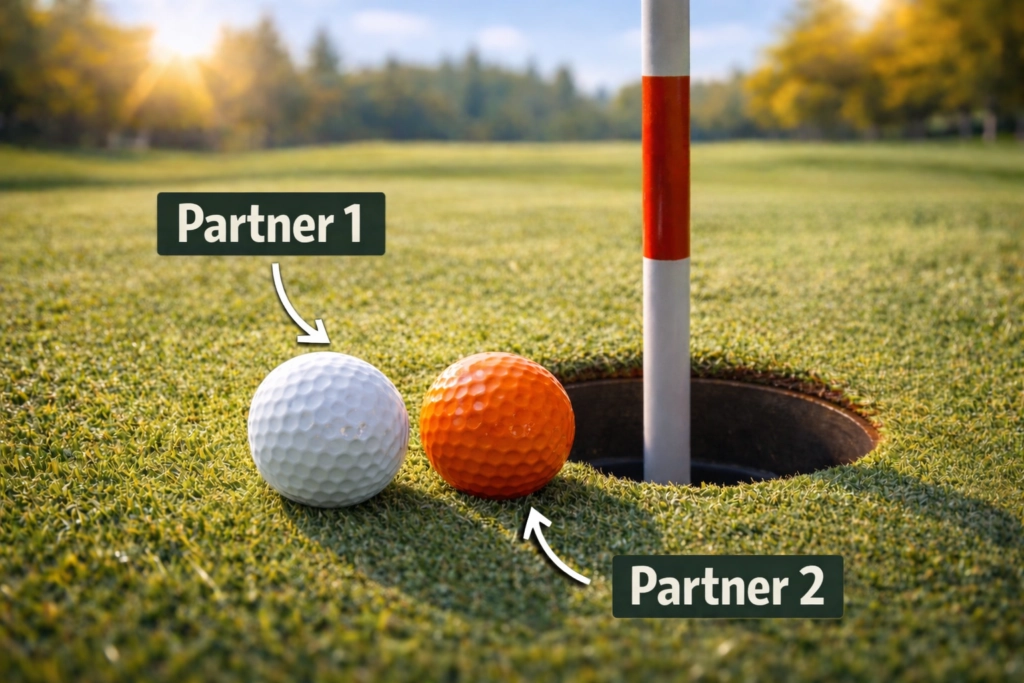
- Confirm the ball-identification procedure: each player should clearly mark their ball so partners can switch and play the correct ball after the tee shots. It makes it easy if you and your partner use different colored balls.
Game Rules
To play Chapman properly, follow the procedure below while also adhering to the standard Rules of Golf (stroke play).
- Tee shots (Stroke 1):
- Both partners play a tee shot with their own ball from the teeing area.
- Switch balls for second strokes (Stroke 2):
- After both tee shots come to rest, the partners exchange balls.
- Each player plays their partner’s ball for the second stroke (Player A plays Player B’s ball; Player B plays Player A’s ball).
- Select which ball to finish out the hole with after the second strokes:
- After both second strokes are played, the team compares the two resulting ball positions.
- The team chooses one ball to continue with for the remainder of the hole.
- The other ball is lifted and is no longer in play for that hole.
- Complete the hole by alternate shots (Stroke 3 onward):
- The player whose second stroke was not selected plays the third stroke.
- Partners then alternate strokes with the chosen ball until the ball is holed.
- Penalty strokes and order of play:
- Apply penalty strokes exactly as the typical Rules of Golf require (e.g., penalty areas, out of bounds, unplayable ball, provisional ball).
- Do not change the alternating order solely because a penalty occurs. Continue with the next player in the established sequence for the chosen ball. (Example: if it is Player A’s turn to play next, and Player B just hit the ball into a water hazard, Player A still plays the next shot.)
How to Keep Score in Chapman Golf Game
How you handle scoring in Chapman depends on whether the competition uses stroke play or match play.
- Stroke play (team score per hole):
- The team records one score for each hole: the total number of strokes taken with the chosen ball, plus any penalty strokes that apply to that ball.
- Add hole scores to obtain the team’s total score for the round. Lowest total score wins (gross or net, as specified).
- Match play (team result per hole):
- The team records one score for each hole as above.
- Compare the team score to the opponent team score on that hole:
- Lower score wins the hole (1 up).
- Equal scores tie the hole (halve).
- The match ends when one team leads by more holes than remain.
Scoring example (single hole, gross scoring)
- Player A drives (Ball A) to the fairway. Player B drives (Ball B) to light rough.
- Second strokes after switching:
- Player A plays Ball B to the front of the green (Stroke 2 on Ball B).
- Player B plays Ball A to the greenside bunker (Stroke 2 on Ball A).
- The team selects Ball B (on the green). The other ball is lifted.
- Because Player A’s second stroke produced the selected ball, Player B plays Stroke 3 (first putt).
- Player A plays Stroke 4, and so on, until the ball is finally holed.
- The team’s score for the hole equals the total strokes taken with Ball B (plus any penalties, if incurred).

How to Determine Winner
- Stroke play: the team with the lowest total score for the stipulated round length wins (gross or net as defined).
- Match play: the team that wins more holes wins the match; a match may also end in a tie (“halved”) if both teams agree or directed to do so by a competition committee.
How to Handle Tie Breakers
Tie-breaking procedures must be decided in advance. Common options include:
- Sudden-death playoff (extra hole) using Chapman procedure on the extra hole. Continue until the tie is broken.
- Scorecard playoff (“countback” method) Determine who had the best score over the final 9 holes. If tied there, determine who had the best score over the final 6 holes. If tied there, determine who had the best score over the final 3 holes. If tied there, determine who had hte best score over the last last hole (gross or net, consistent with the agreed format).
- Aggregate playoff holes (e.g., 3-hole total) using Chapman on each playoff hole.
If handicaps are used, then you should consider how handicap strokes apply on extra holes.
Tips and Strategies for Chapman Golf Game
Chapman rewards teams that plan each hole around (1) two tee shots, (2) two second shots played with swapped balls, and (3) the third shot that begins alternate-shot pressure.
- When to play aggressive
- Attack when the team can create a high-upside “best second shot” decision. Example: if one player excels with approach shots, allow that player to play the second stroke on the ball most likely to produce a scoring chance, then plan for the partner to play the third.
- Use aggressive lines off the tee when the partner can stabilize the hole with a reliable second stroke from the swapped ball.
- When to play safe
- Favor conservative tee shots when hazards bring big penalties into play. Chapman does not allow a “free rescue” once the team commits to the chosen ball and alternate-shot finish; a single mistake can force a difficult recovery when alternating shots.
- Choose the continuation ball after the second strokes based on position and next-player advantage, not distance alone. The third stroke often decides the hole’s direction.
- Common mistakes
- Ignoring who plays Stroke 3. Since the non-selected second-stroke player hits next, the team should confirm who will face the critical third shot before choosing.
- Ball confusion after switching. Clear markings and verbal confirmation prevent playing the wrong ball after drives.

Variations of Chapman
There are a few different variations you can try out when playing Chapman. Below are a few to consider.
- Modified Pinehurst / Greensomes: Many groups remove the “switch balls for the second stroke” requirement. Partners typically select the better drive, then play alternate shot from that spot. This changes strategy significantly because it emphasizes driving and immediate alternate-shot execution rather than the swapped second-stroke decision.
- Net Chapman events: Apply a published handicap allowance to create Playing Handicaps, then score the round as net stroke play or net match play. The USGA’s recommended allowance for Pinehurst/Chapman is 60% of the lower-handicap player plus 40% of the higher-handicap player for the team. This is difficult to implement but highly recommended if there are high stakes or serious bragging rights are involved.
- Stableford Chapman: Some may elect to use Stableford scoring for the team’s hole score (gross or net). The Chapman procedure of play remains unchanged; only the scoring method changes.
FAQs about Chapman
Does Chapman work with handicaps?
Yes. In a tournament format, you may run Chapman as a net competition by converting each player’s Handicap Index into a Course Handicap and then applying a team allowance.
The USGA’s recommended handicap allowance for Pinehurst/Chapman is 60% of the lower-handicap partner plus 40% of the higher-handicap partner, combined to form the team Playing Handicap.
Is Chapman for beginners?
Chapman can suit beginners when paired with an experienced partner because the team selects the better ball after two strokes. This can reduce the impact of a single poor shot early in the hole.
However, the alternate-shot finish demands basic golf skills and rules knowledge (especially penalty procedures) and careful pre-shot planning because partners must execute in sequence with no option to choose again after committing to the continuation ball.
Final Thoughts on Chapman
Here at Golf Games Hub, we love playing Chapman because it creates a true team test without turning the round into a pure scramble.
The format forces every side to manage risk, communicate clearly, and execute under alternate-shot pressure once the team commits to the chosen ball.
Chapman also produces balanced competition across mixed-ability partners because it blends independent play (two tee shots and two second shots) with shared responsibility (the alternate-shot finish).
When handicaps and tie-breaks are handled cleanly, Chapman delivers a fair, structured, and engaging round that stays competitive from the first tee to the final putt.

Other Fun Golf Game Formats to Consider Besides Chapman
We know golf games here at Golf Games Hub. If you enjoy playing Chapman, you’re going to absolutely love playing these other golf game formats.
Stableford flips traditional golf scoring on its head and rewards bold, aggressive play instead of punishing bad holes. Because points are earned relative to performance on each hole, players can recover quickly and take calculated risks without fear of one disaster ruining the entire round. It’s competitive, pace-friendly, and widely used in tournaments around the world.
Vegas is a high-energy team betting game where two teams of two combine their scores into a two-digit number (for example, 4 and 5 become 45). The team with the lower number wins the hole, and the difference between the numbers determines the payout. Because scores compound quickly, a single bad hole can dramatically swing the match, making Vegas one of the most exciting betting formats in golf.
Wolf is a high-pressure, rotating golf game where every hole forces one player to make a bold decision that can swing the entire round. It blends strategy, timing, and calculated risk in a way that keeps all four players fully engaged from the first tee to the final putt.




Leave a Reply