


To understand how to play Skins is to understand one of golf’s purest pressure formats.
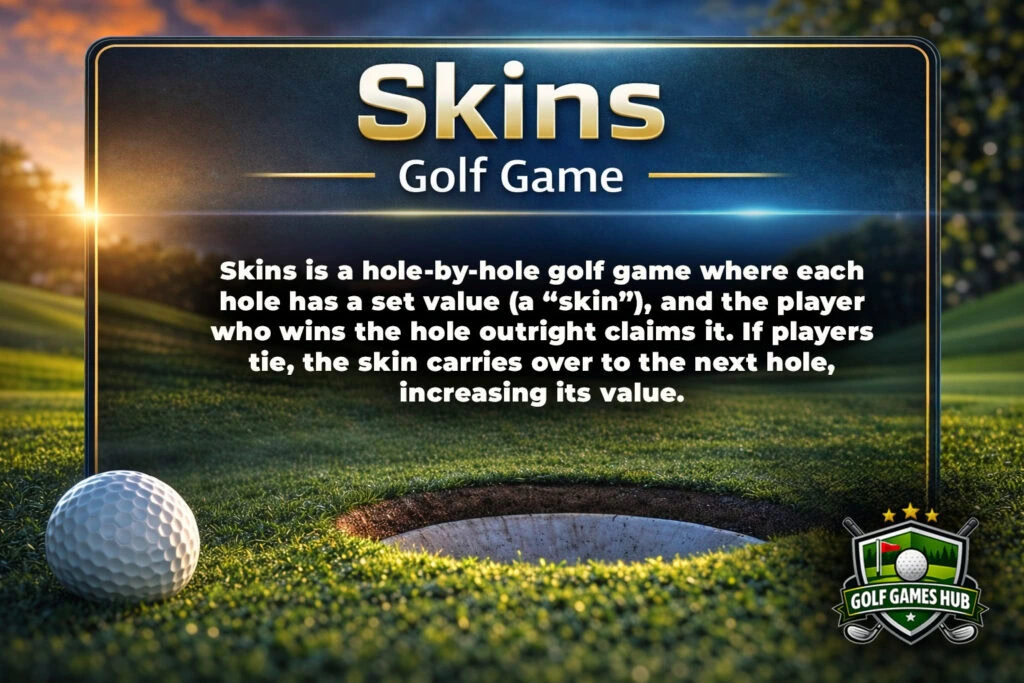
In Skins, each hole carries a set value in money or points. If one player posts the outright low score, that player wins the skin. If two or more players tie for the low score, no one wins the hole, and that skin carries forward to the next hole, increasing its value.
This simple structure creates intense momentum swings, aggressive decision-making, and dramatic finishes without changing the underlying Rules of Golf.
The following article aims to thoroughly and concisely cover how to play Skins including game setup, rules, strategies, and some important varitations to consider.

Quick Summary / TL;DR
Skins is a hole-by-hole betting golf game that works best with three or four players.
A skin reperesents a monetary value for winning each hole. Depending on your group, this could be $1 or $100 or more.
Each player contributes the skin value x 18 to the pot.
On every hole, all players play their own ball under the normal Rules of Golf, counting all strokes and penalties. After the hole ends, the group compares scores.
In Gross Skins, the lowest actual score wins the skin.
In Net Skins, apply handicap strokes first, then compare net scores to determine who wins the skin.
A player must post the sole low score to win the skin on a given hole. If the low score is tied, nobody wins that hole. The skin carries over to the next hole, making the next hole worth two skins, then three, and so on until someone wins a hole outright. Anyone can win the carried over skin(s), not just those who tied on the previous hole(s).
If the 18th hole ties with skins still unclaimed, the cleanest method is sudden death unless the group agreed in advance to split the remaining value.
After the round is complete, skin winnings are divvied out from the original pot.
That is enough to start playing immediately, but the full rules, handicap methods, strategy, and variations explained below make the game cleaner, fairer, and more enjoyable.
How To Play Skins
The core of Skins is simple, but, because money is usually on the line, the game works best when every detail is figured out before the first tee shot. This section lays out the full standard procedure.
Number of Players Or Teams Required
Skins is most commonly played with three or four players in one group. That structure creates enough scoring variation to make carryovers meaningful while still keeping the game easy to track. Two players can play Skins, but in practice that version feels much closer to a hole-by-hole match.
Larger events can also run Skins across multiple groups, but that requires centralized scoring and a clearly stated payout method.
Skins is usually an individual game. Each player competes for each hole independently. Team-based Skins formats exist, but standard Skins should be treated as an individual competition unless the group expressly adopts a team variation.
Skins Game Setup
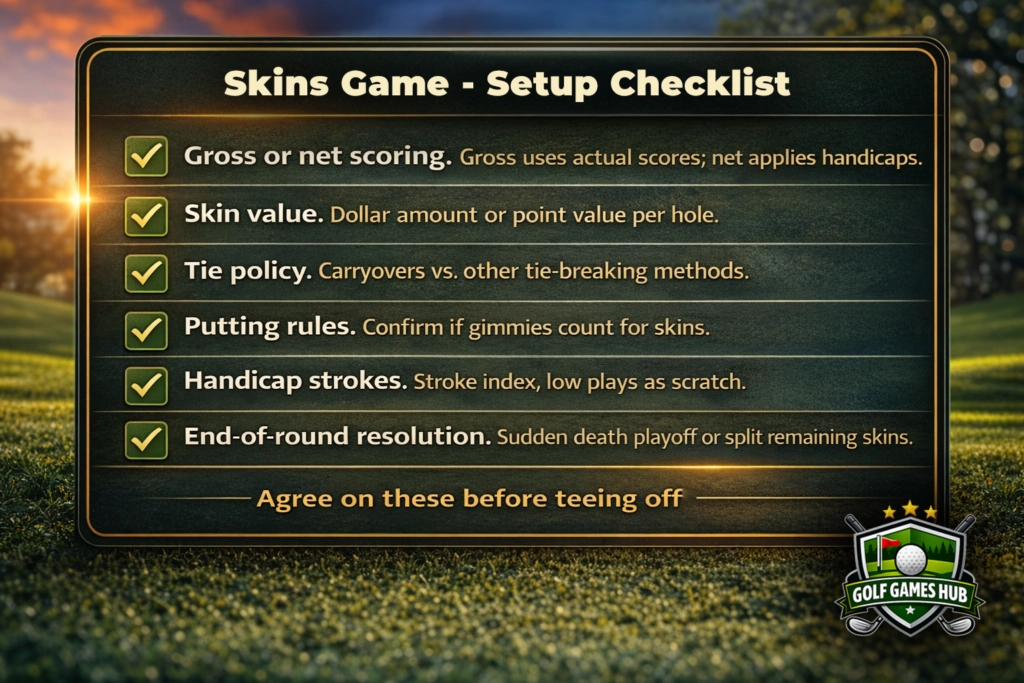
Before teeing off, the group should agree on six items:
- Gross or net scoring.
Gross Skins uses actual scores. Net Skins applies handicap strokes before determining the low score. - Value of each skin.
The group may assign a dollar amount, a point value, or a fixed pot contribution. A common model is one agreed unit per player per hole. - Tie policy.
Standard Skins uses carryovers. If the low score ties, the skin rolls to the next hole. - Putting policy.
The soundest method is no gimmies on any putt that could win or tie a skin. A player should hole out to claim a skin. - Handicap method.
If playing net Skins, the group should use Course Handicap and Playing Handicap, then apply strokes by stroke index. The cleanest default is to play off the low handicap. Meaning, the player with the lowest handicap index is treated as having a zero (or near-zero) handicap for that round, and everyone else receives strokes based on their difference from that person. - End-of-round resolution.
If unclaimed skins remain after the 18th hole, the group should decide in advance whether to use sudden death, split the remaining bank, or use another agreed procedure.
These pre-round agreements are not optional in a well-run Skins game. Skins is a wager format built on clear terms. The better the setup, the fewer the disputes later.
Skin Golf Game rules
Each player plays every hole under the normal Rules of Golf. After all relevant scores are completed, determine which player recorded the low score on that hole.
The rules for awarding a skin are as follows:
- A player wins a skin only by recording the sole low score on the hole.
- If two or more players tie for the low score, no skin is awarded on that hole.
- Any unawarded skin carries over to the next hole.
- Once a player wins a carried-over hole outright, that player wins all banked skins, and the next hole returns to a value of one skin.
Example:
- On Hole 1, Player A makes par, and every other player makes bogey or worse. Player A wins that skin.
- On Hole 2, Players B and C both make par, which is the low score. No skin is awarded. Hole 3 is now worth two skins.
- On Hole 3, Player D makes the sole birdie. Player D wins both skins from Holes 2 and 3.
That rolling structure is what gives Skins its character. A quiet round can turn instantly on one hole if several skins have carried forward.
How To Keep Score in Skins Golf Game
A Skins scorecard should track hole-by-hole winners and the carryover bank of skins. Total strokes for the round do not determine the winner of the Skins game, but they should be recorded since each hole is decided by score.
How to Determine The Winner in Skins
Skins does not produce one winner through aggregate strokes. It produces winners one hole at a time.
At the end of the round, the overall Skins winner is the player who won the greatest number of skins or, in a money game, the player who won the greatest total value.
A player can shoot a higher overall round than another player and still win the Skins game. That outcome is normal. Skins rewards timely low holes, not steady accumulation across 18 holes.
That is why Skins remains popular. It keeps every hole live and gives explosive scorers a real advantage.
How to Handle Handicaps in Skins (Further Explained)
Skins can be played gross or net. Gross Skins is the cleanest and simplest form. Net Skins is useful when skill levels vary.
For Net Skins, the best and default method is:
- Determine each player’s Course Handicap and Playing Handicap.
- Identify the lowest Playing Handicap in the group.
- Subtract that lowest number from every other player’s Playing Handicap.
- Apply the resulting difference by stroke index.
Example:
Player A: 6 handicap
Player B: 12 handicap
Player C: 18 handicap
Player D: 22 handicap
Playing off the low handicap:
- A gets 0 strokes
- B gets 6 strokes
- C gets 12 strokes
- D gets 16 strokes
Player B receives a stroke on the 1-6 hardest holes (see your scorecard). Player C receives a stroke on the 1-12 hardest holes and Player D receives strokes on each of the 16 hardest holes on the course.
So on each hole where a stroke is received, these players would subtract 1 stroke from their gross score to determine their net score. The net score determines who won the hole.
This method keeps the competition relative to the players in the game rather than to par. Some groups use reduced allowances such as 80% or 90%, or cap strokes at one per hole, but those are house rules and should be adopted only by agreement before play.

How to Handle Tie Breakers
A tie on an individual hole is not a tiebreaker situation in standard Skins. It is a carryover. No one wins the skin, and the value moves forward.
The true tiebreaker issue arises at the end of the round if skins remain unclaimed after Hole 18. The best standard procedure is:
- Continue to extra holes in sudden death.
- On each extra hole, a player must win outright with the sole low score.
- Once someone wins, that player takes all banked skins through hole 18 only. The extra holes do not typically carry additional skins value.
If time, weather, or daylight prevents extra holes, the group may instead agree before the round to split the remaining skins or settle them by another defined method. That method must be stated before play begins.
Nothing creates more conflict and confusion than inventing a settlement rule after hole 18 is complete.
Holing Out, Gimmies, and Pickups
This point deserves its own clarification because it causes constant disputes when playing Skins. In a proper Skins game:
- A player should hole out to win a skin.
- No putt that could win or tie a skin should ever be conceded.
- A player who cannot possibly win the hole may pick up for pace of play, but that player becomes ineligible to win the skin on that hole.
Settlement and Administration
The cleanest money procedure is to fund the pot before the round starts. That prevents awkward settlement issues on the final green and keeps the game orderly.
One player should also serve as the official scorer, or the group should use a scoring app that all players accept.
Skins is simple only when it is administered cleanly. State the rules early, track winners accurately, and settle the game exactly as agreed.
Tips and Strategies for Skins
Skins rewards timing more than consistency, so strategy should change with the value of the hole. That is where this format becomes especially interesting.
Play aggressively when multiple skins have carried over and the hole offers a realistic birdie opportunity. The value of that hole is higher, so the reward often justifies taking on more risk. A tucked pin, reachable par 5, or short par 4 can justify a bold line when three or four skins sit in the bank.
Play more conservatively when only one skin is at stake and the field is unlikely to make birdie. On a difficult par 4, a steady par often applies enough pressure.
In net Skins, conservative strategy can be even stronger on holes where one or more opponents already receive handicap strokes.
The most common mistakes are strategic, not mechanical. Players often chase hero shots on low-value holes, concede putts too casually, or forget that a tied low score helps nobody.
Another common error is poor administration. If the group fails to define handicaps, gimmies, or the 18th-hole procedure before the round, disputes become likely.
The best Skins players stay aware of context. They know the value of the current hole, the scoring tendencies of the field, and whether a safe par or an aggressive birdie attempt gives the stronger chance to win outright.

Variations of Skins Golf Game
Once the standard game is understood, several common variations can add a different flavor to this golf format. These should be treated as house rules and adopted only before the round begins.
- No-Carryover Skins voids a skin when a hole ties. The value does not roll forward. This version reduces volatility and works well for higher stakes or mixed-skill groups.
- Split Skins awards the tied hole’s value equally among the tied low scorers. This softens the drama of carryovers but creates steadier payouts.
- Back-Nine Multiplier increases the value of later holes, often by doubling the skins on Holes 10 through 18. This keeps the round live deep into the back nine.
- Validation Skins requires a player not only to win a skin but also to validate it on the next hole by tying or beating the field again. If not validated, that skin can return to the pool. This is a more advanced format and requires careful tracking.
- Round Skins compares scores from multiple groups after all rounds finish. That version is useful for leagues and events but needs centralized scoring and precise handicap procedures.
For most groups, standard carryover Skins remains the best version because it preserves the format’s defining pressure and simplicity.
FAQs About Skins Golf Game
This final section addresses the questions that create the most confusion and brings the format to a clean close.
Does Skins work with handicaps?
Yes. Skins can be played gross or net. Gross is simpler. Net Skins works best when the group uses Course Handicap and Playing Handicap, then plays off the low handicap and allocates strokes by stroke index.
Is Skins a good game for beginners?
Yes, especially in a friendly group. A beginner may struggle to win many holes in Gross Skins, but Net Skins can make the game competitive. The format also keeps weaker players engaged because one good hole can still win value.
Is Skins match play or stroke play?
Skins is best described as a hole-by-hole competition layered on top of normal stroke scoring. Players count strokes on each hole, but the contest resets on every new tee.
If two players tie for the low score, do they split the skin?
Not in standard Skins. A tie for low means nobody wins the hole, and the skin carries over. Splitting is a house-rule variation only.
Do players have to hole out?
A player should hole out on any putt that could win or tie a skin. Pickup is acceptable only when the player can no longer affect the result of the hole.
What happens if no one wins the final skin on 18?
The best default is sudden-death playoff holes until someone wins outright. If the group prefers another method, it should be agreed before the round begins.

Final Thoughts on Skins
Here at Golf Games Hub, we love Skins because it captures everything that makes golf games memorable: pressure, momentum, recovery, and the chance for one bold shot to change the entire day.
A player never needs a perfect round to stay in the fight. One birdie at the right time can erase a quiet front nine and swing the match instantly. That gives Skins unusual drama without making the rules hard to follow.
Skins also scales beautifully. It works as a simple weekend money game, a net game for mixed abilities, or a more advanced format with custom variations.
When the group defines the rules clearly before the first tee shot, Skins delivers one of the sharpest and most competitive experiences in golf.
Other Fun Golf Game Formats to Consider
If you enjoy the strategic side of Skins, be sure to explore our Traditional Golf Games Collection. If you prefer formats that lean more toward fun, creativity, and social interaction during the round, our Fun & Social Golf Games Collection is packed with great options.
Of course, we also have a Collection of Betting Formats.
Below are a few of our favorite golf games worth trying on your next round.
Nassau splits the round into three separate contests: the front nine, the back nine, and the overall match. This structure keeps every player engaged throughout the round since a slow start on the front nine doesn’t eliminate your chances to win later segments. With straightforward scoring and multiple opportunities to stay competitive, Nassau remains a go-to format for both friendly rounds and serious wagers.
Wolf is a rotating betting game that blends strategy, risk, and player psychology. Each hole, one golfer becomes the “Wolf” and decides whether to partner with another player after seeing their tee shot or take on the rest of the group alone for a bigger reward. Because decisions must be made in real time and often under pressure, Wolf creates constant tension and rewards both confidence and smart judgment.
Vegas is a high-action two-versus-two betting format famous for its dramatic score swings. Instead of adding partner scores together, each team combines them into a two-digit number. For example, a partner score of 4 and 7 becomes 74. One poor score can drastically change the outcome of a hole. Vegas rewards steady play, smart risk management, and the ability to stay composed when the stakes climb.
Quota is a points-based game that levels the playing field between golfers of different skill levels. Each player starts the round with a personalized point target—known as their quota—and earns points for results like bogeys, pars, birdies, and better. The goal isn’t simply to shoot the lowest score, but to beat your individual quota by the largest margin. Because every player is competing against their own benchmark, Quota keeps the entire group engaged and competitive from the first tee to the final putt.



Leave a Reply