


There are lots of golf formats that we love around here, and one of our favorites is the Vegas golf game.
So, how do you play Vegas?
Vegas is a four-player golf betting game played as two teams of two, where each player plays their own ball and the partners’ scores combine to form a two-digit team number on every hole (for example, scores of 4 and 5 become 45).
The team with the lower number wins the hole, and the difference between the two numbers determines the points or wager amount.
Vegas is one of the most exciting partner betting games in golf because every hole can swing dramatically depending on how the team scores combine.
Since both partners’ scores form a two-digit number, one big number can explode the difference, which makes Vegas fast-paced, high-pressure, and incredibly fun for competitive foursomes.
The sections below outline the official method of play, scoring procedures, and strategy considerations necessary to properly administer and enjoy the Vegas format.

Quick Summary / TLDR
Vegas is played by four golfers divided into two teams of two.
Each player plays their own ball for the entire hole under normal stroke play. After both partners finish the hole, the two individual scores combine to form a two-digit team score.
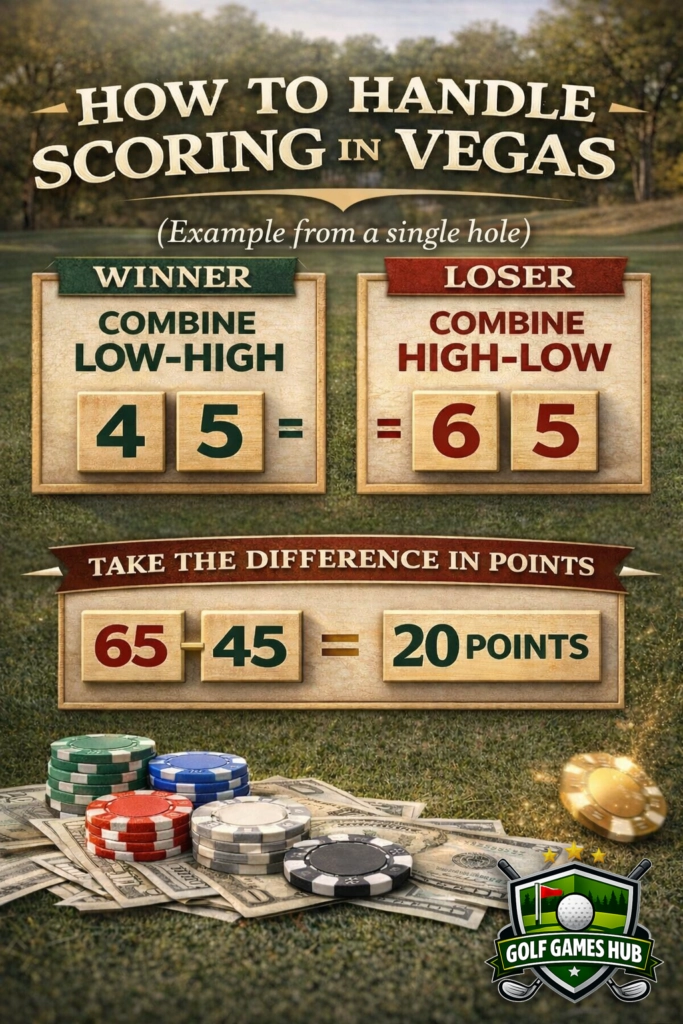
For the team with the lower individual scores, the lower score becomes the first digit and the higher score becomes the second digit. For example, if one partner makes 4 and the other makes 5, the team score becomes 45.
The opposing team’s scores also combine into a two-digit number. However, if their total is worse than the winning team, the higher score is placed first and the lower score second. For example, scores of 5 and 6 become 65, not 56.
This reversal increases the gap between the teams and creates the large swings that define Vegas.
The difference between the two team numbers represents the points or wager value for that hole.
Example:
- Team A scores 4 and 5 → 45
- Team B scores 5 and 6 → 65
Team A wins 20 points.
Play continues for the full round and the team with the lowest cumulative score or highest points won is declared the winner.
Continue reading for the full rules, scoring method, variations, and strategic considerations that make Vegas one of the most exciting team formats in golf.
How to Play Vegas Golf Game
Vegas is a simple four-player team game that can lead to some big scoring swings. Two teams compete on every hole, and the way the scores combine can quickly turn a small win into a huge one.
The sections below walk through exactly how to set up and play a Vegas match from start to finish.
Number of Players / Teams Required
Vegas requires four players divided into two teams of two.
Each player competes using their own golf ball throughout the entire round.
Every stroke counts under the normal Rules of Golf.
Vegas Game Setup
Before you tee off, the group should agree on a few basic things that will apply for the round.
1. Establish Teams
Divide the four players into two teams of two.
2. Determine Wager or Point Value
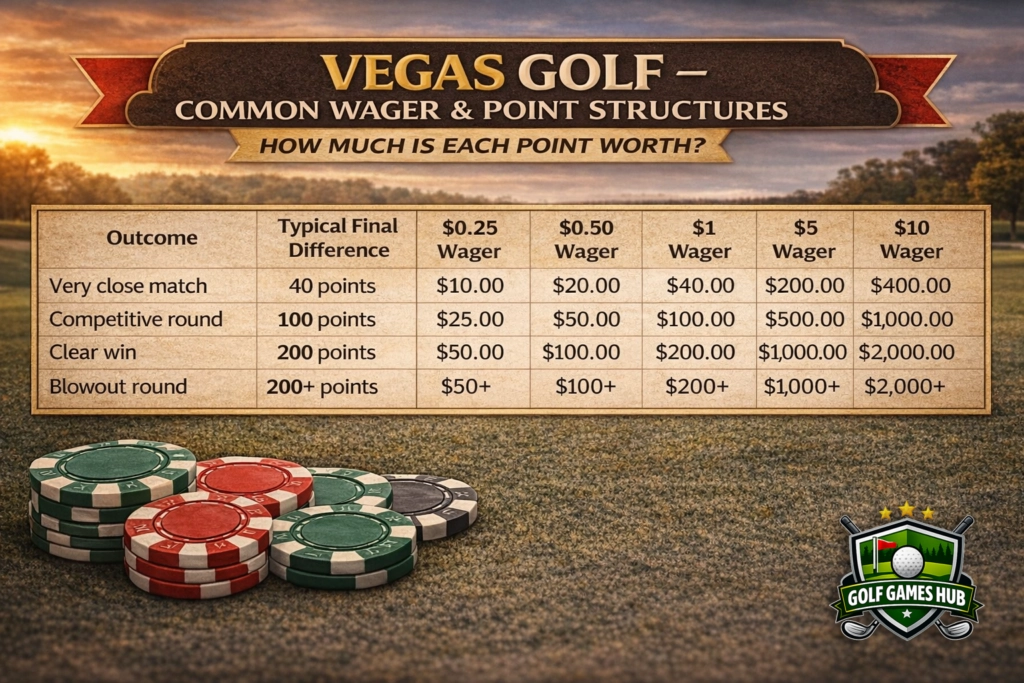
Vegas is frequently played as a wagering game. Players must agree on the value of each point before teeing off.
Example point structures:
- $0.10 per point
- $0.25 per point
- $1 per point
Because scores can grow large, selecting an appropriate point value is important.
3. Determine Handicap Usage
Players may choose:
- Gross scoring (no handicaps), or
- Net scoring (handicap strokes applied)
If handicaps are used, apply strokes before combining the scores.
4. Determine Any Variations
Common options include:
- Double birdie multiplier
- Double-digit multipliers
- Maximum hole limits
If variations are used, they must be agreed upon before play begins. Check out the Variations section below for how these variations work.
Once you’ve decided on your Vegas golf format, proceed to play under standard golf rules.
Vegas Golf Game Rules
Each player completes every hole using their own ball.
The objective is to produce the lowest possible combined two-digit score for the team.
Follow these steps for each hole:
Step 1: All players play the hole
Each golfer tees off and continues play until their ball is holed.
Step 2: Record individual scores
Record the number of strokes each player takes on the hole.
Step 3: Form team scores
Each team forms a two-digit number using both partners’ scores.
For the team with the lower combined performance (with both scores simply added together), arrange the digits from lowest to highest.
Example:
Player A: 4
Player B: 5
Combined score = 4 + 5 = 9
Team score becomes 45.
For the team with the higher combined performance, reverse the digits so the higher score comes first.
Example:
Player C: 5
Player D: 6
Combined score = 5 + 6 = 11
Team score becomes 65.
This rule intentionally increases the gap between the teams.
Step 4: Determine the hole result
Subtract the lower team number from the higher team number.
Example:
65 − 45 = 20 points
The lower team number wins the hole and earns the difference.
Vegas Golf Games Scoring
Vegas scoring requires recording the two-digit team numbers on each hole.
A typical scorecard might appear as follows:
| Hole | Team A Scores | Team A Number | Team B Scores | Team B Number | Points Won |
|---|---|---|---|---|---|
| 1 | 4, 5 | 45 | 5, 6 | 65 | 20 (A) |
| 2 | 4, 4 | 44 | 4, 5 | 54 | 10 (A) |
| 3 | 5, 6 | 65 | 4, 4 | 44 | 21 (B) |
Continue recording results for all holes.
At the end of the round, add all points to determine the final result and winner.
How to Determine the Winner
After the final hole, calculate the total points accumulated across the entire round.
The team with the greater number of points won is declared the winner.
Example final tally:
- Team A: 75 points
- Team B: 35 points
If a wager applies, multiply the total points by the agreed point value.
Example:
Team A won by 40 points × $0.25 = $10.00
This amount represents the payment from the losing team to the winning team.
How to Handle Tie Breakers
A tie can occur if both teams finish the round with equal point totals.
Groups typically resolve ties using one of the following methods:
Option 1: Sudden Death Hole
Play an additional hole. Apply the standard Vegas scoring procedure. The team that wins the hole wins the match.
Option 2: Countback Method
Compare results in the following order:
- Last 9 holes (most points wins). If tied, then…
- Last 6 holes (most points wins). If still tied, then…
- Last 3 holes (most points wins). If still tied, then…
- 18th hole
The team with the better result in the segment wins the match.
Option 3: Simply Call It A Tie
If agreed, you may simply end the game in a tie.

Tips and Strategies for Vegas
Vegas rewards consistent scoring from both partners. Because both scores form the team number, one poor hole can create a very large loss.
Understanding when to apply pressure and when to limit damage plays a major role in winning chances.
When to Play Aggressive
Aggressive play makes sense when:
- Both opponents already hold high scores on the hole
- A birdie opportunity exists
- The partner has already secured a strong score
Example:
If a partner records a 4, an aggressive attempt at birdie could create a 34, which often produces a large swing against opponents.
When to Play Safe
Conservative play becomes critical when:
- A partner already holds a high score
- Hazards guard the green
- A double bogey would significantly increase the team number
Avoiding an 8 or 9 prevents the team score from becoming something like 89, which can produce extremely large point losses.
Common Mistakes
Several mistakes frequently occur in Vegas matches:
- Ignoring risk after a partner records a high score
- Misunderstanding digit reversal rules
- Failing to set wagering limits before play
- Apply handicaps incorrectly
Teams that play conservatively and avoid large numbers often outperform more aggressive teams over a full round.
Variations of Vegas Golf Game
Many groups modify the basic Vegas rules to increase excitement or raise the stakes.
Double Birdie Multiplier
If both partners make birdie on the same hole, the final difference doubles.
Double Digit Multiplier
If both teams are really looking to make serious bets, then you may opt to multiply the points by 2 to get larger point swings.
Par Protection Rule
Some groups prevent digit reversal when both teams make par or better.
This reduces extreme scoring swings.
Maximum Hole Limits
Some groups may desire a more friendly version of Vegas and opt for smaller swings to keep the game more friendly. In this instance, point caps can be used.
Common limits include:
- 30-point cap per hole
- 50-point cap per hole
Groups should confirm all variations before play begins to avoid disputes during the round.
FAQs About Vegas
Vegas scoring can appear confusing at first because it differs from most golf formats. The following questions clarify the most common points of confusion.
Does Vegas work with handicaps?
Yes. Vegas works well with handicaps.
Apply handicap strokes to each player’s hole score before forming the team number. The adjusted scores determine the digits.
Example:
- Player score: 5
- Handicap stroke: 1
Net score becomes 4 for scoring purposes.
Using handicaps often produces more balanced matches between players of different ability levels.
Is Vegas suitable for beginners?
Vegas can accommodate beginners, but new players should use small point values or play purely for points without wagering.
Because the scoring method can create large numbers, inexperienced players may find the format intimidating if stakes become too high.
Lower wagers and clear scoring explanation make the game enjoyable for all skill levels.
Why does Vegas reverse the digits for the losing team?
Digit reversal creates larger scoring swings and increases competitive pressure. A poor score from one player can dramatically increase the team number, encouraging both partners to stay engaged on every shot.
This feature distinguishes Vegas from other golf formats.
Can Vegas be played with more than four players?
The traditional Vegas format requires exactly four players. Larger groups typically run multiple Vegas matches simultaneously.

Final Thoughts on Vegas
Here at Golf Games Hub, we appreciate games that create excitement, teamwork, and strategic decision-making throughout an entire round. Vegas accomplishes all three. The format rewards consistency from both partners while still allowing dramatic scoring swings that keep every hole interesting. Few formats punish careless play and reward strong teamwork like Vegas does.
Vegas also adapts easily to different groups. Players can adjust the point value, apply handicaps, or introduce variations to match the competitiveness of the group. Whether played for small stakes, large stakes, or simple bragging rights, Vegas consistently delivers one of the most thrilling team golf experiences in the game.
Other Fun Golf Game Formats to Consider Besides Vegas
We know golf games here at Golf Games Hub. If you enjoy playing Vegas, you’re going to absolutely love playing these other golf game formats.
Chapman is a popular two-person team format that blends individual shot-making with teamwork and strategy. Both players hit a tee shot, then switch and play their partner’s ball for the second shot before choosing the best position and finishing the hole using alternate shots. The format creates constant decision-making and rewards strong teamwork, making it a favorite for tournaments and friendly competitions alike.
Nassau is one of the most widely played betting formats in golf because it divides a round into several smaller matches. By splitting the competition into the front nine, back nine, and overall match, players always have a chance to recover even after a slow start. The game also introduces the concept of a “press,” allowing golfers to start a new wager during the round and create additional chances to win.
Stableford uses a point-based scoring system that encourages players to attack rather than play defensively. Instead of counting total strokes for the entire round, points are awarded based on performance on each individual hole. This structure limits the damage of a bad hole, speeds up play, and rewards aggressive shot-making, which explains why the format is used in many amateur and professional competitions worldwide.




Leave a Reply