


Quota is one of golf’s most popular points-based formats.
In Quota, every player competes against their own scoring target rather than the entire field—this guide explains how to play Quota.
Quota is a points-based golf game that balances competition among players of different skill levels.
In Quota, players earn points on each hole based on performance relative to par.
Each player begins the round with a point quota (derived from their handicap), and the objective is to meet or exceed that quota during the round.
This golf format rewards strong individual holes rather than purely low stroke totals, which keeps every player competitive throughout the round. Even after a difficult hole, a player can recover by earning points on later holes.
The sections below explain exactly how to set up the game, calculate quotas, keep score, and determine the winner.

Quick Summary / TL;DR
Quota is a points-based golf format where players compete to exceed a personal scoring target calculated from their handicap.
Before the round begins:
- Each player’s handicap determines their Quota target
- The standard formula is:
Quota = 36 – Handicap
Example:
- Player A handicap: 12
- Quota: 36 − 12 = 24
Players then earn points on each hole according to performance relative to par:
| Score | Points |
|---|---|
| Double Bogey or Worse | 0 |
| Bogey | 1 |
| Par | 2 |
| Birdie | 4 |
| Eagle | 8 |
During the round, each player records points earned per hole. After 18 holes, players compare their total points to their Quota target.
The winner is the player who exceeds their quota by the greatest margin or the player who gets closest to reaching their quota if nobody meets it.
Quota works well for groups of any size and keeps every hole meaningful.
Continue reading to learn the complete rules, scoring procedures, strategic considerations, and common variations of this highly popular points-based golf game.
How to Play Quota Golf Game
This section explains the official procedures for organizing and playing a round of Quota.
Number of Players / Teams Required
Quota is primarily an individual competition.
- Minimum players: 2
- Typical group size: 3–4 players
- Larger groups may compete simultaneously by comparing results at the end of the round.
The format also supports optional side bets or team pairings, but the core structure remains individual scoring against a quota target. See more of our betting games and team games, if interested.
Once players have established the group size, they must determine each player’s handicap and quota before play begins.
Quota Game Setup
The game begins with establishing each player’s Quota target.
Step 1 – Determine Handicap
Use one of the following:
- Official GHIN handicap index
- Course handicap calculated from the scorecard
- Agreed estimate if players do not maintain official handicaps
Step 2 – Calculate Quota Target
The most common formula is:
Quota = 36 − Handicap
Examples:
| Handicap | Quota |
|---|---|
| 5 | 31 |
| 10 | 26 |
| 15 | 21 |
| 20 | 16 |
Lower-handicap players must score more points to reach their quota, while higher-handicap players have lower targets.
Step 3 – Establish Scoring System
Players must confirm the point values used for hole results.
Standard Quota scoring:
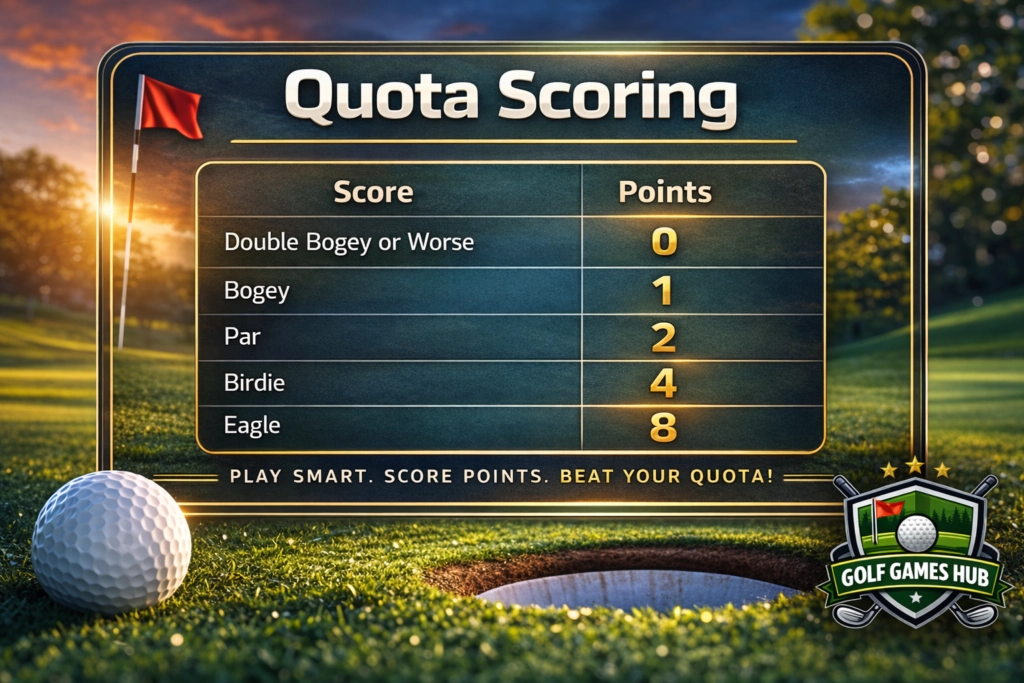
This scoring structure heavily rewards strong holes.
After setup is complete, play begins under the normal Rules of Golf (count strokes, apply penalties).
Game Rules
Quota uses standard stroke play procedures for playing each hole.
Players must:
- Play their own ball throughout the hole
- Count all strokes, including penalties
- Complete each hole unless the group agrees to pick up once no points are possible
Each hole produces a scoring result relative to par.
Example:
Hole 4 – Par 4
Player scores 5
Result: Bogey
Points earned for the hole: 1
Quota does not use match play or head-to-head hole scoring. Each player competes only against their quota target.
Because points vary significantly between results, a single birdie can dramatically change a player’s standing.
How to Keep Score in Quota Golf
Players maintain two scoring columns during the round:
- Stroke score
- Quota points earned
Example scorecard section:
| Hole | Par | Score | Result | Points |
|---|---|---|---|---|
| 1 | 4 | 5 | Bogey | 1 |
| 2 | 3 | 3 | Par | 2 |
| 3 | 5 | 4 | Birdie | 4 |
| 4 | 4 | 6 | Double Bogey | 0 |
Total Points = Sum of all points earned for the round
Players then compare this total against their quota target.
How to Determine the Winner
The winner is the player who finishes furthest above their quota.
Calculation:
Final Score = Total Points − Quota
Example:
| Player | Quota | Points Earned | Result |
|---|---|---|---|
| Player A | 24 | 28 | +4 |
| Player B | 20 | 16 | -4 |
| Player C | 18 | 18 | 0 |
Player A wins with +4 points.
A negative score means the player did not reach their quota.
How to Handle Tie Breakers
If two or more players finish with identical scores relative to their quota, use one of the following tie-breaking methods.
Common options include:
Back-Nine Countback
Compare points earned on holes 10–18. The highest total wins.
Last Six Holes
If a tie still remains, compare points earned on holes 13–18. The highest total wins.
Last Hole
If a tie still remains, compare points on hole 18.
Playoff Hole
Groups may elect to play an additional sudden-death hole.
Agree on the tie-breaker procedure before the round begins, especially if playing in a tournament format.
Tips and Strategies for Quota
Quota rewards calculated aggression and intelligent risk management.
When to Play Aggressive
Players should attack scoring opportunities when:
- Approaching reachable par-5 holes
- Facing short par-4 approach shots
- Holding a comfortable lie in the fairway
Birdies provide double the value of pars, making them extremely valuable.
Example:
- Two pars = 4 points
- One birdie = 4 points
This scoring system makes aggressive play worthwhile when conditions allow.
When to Play Safe
Players should adopt a conservative strategy when:
- Recovering from trouble
- Protecting a strong round
- Facing difficult hole locations
Securing a bogey still earns 1 point, which often prevents falling behind quota pace.
Avoid compounding mistakes!
Common Mistakes
Players frequently make the following errors:
- Chasing birdies unnecessarily after poor holes
- Forgetting to track quota progress during the round
- Playing too conservatively despite birdie opportunities
Successful players monitor their quota status and adjust strategy accordingly.
Variations of Quota
Several variations add different strategic layers to the standard Quota format.
Modified Point Systems
Some groups use alternate point values:
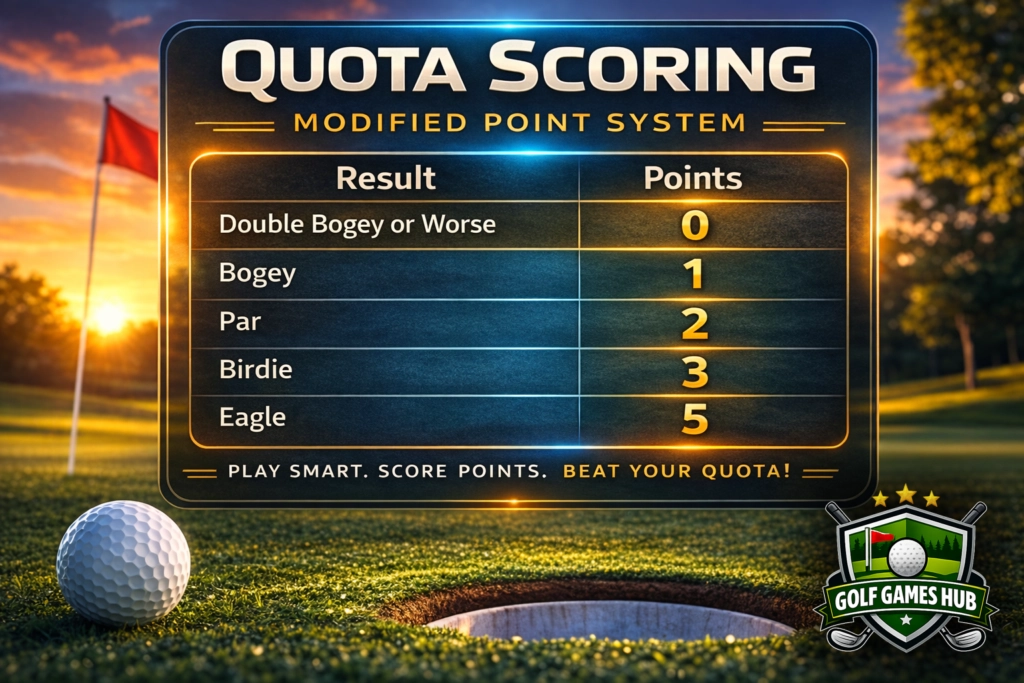
This compresses scoring volatility.
Team Quota Golf
Players form teams and combine quota targets.
Example:
Player A quota: 24
Player B quota: 20
Team quota: 44
Team points are combined to determine whether or not they have exceeded their quota.
Reverse Quota
Players attempt to finish closest to zero, meaning they neither exceed nor fall short of their quota significantly.
This variation rewards consistent play and teaches you to not be agressive just to go lower – an important skill for scoring a good round!
FAQs about Quota
Does Quota work with handicaps?
Yes. Quota is specifically designed to incorporate handicaps. The quota target is calculated from a player’s handicap using the formula 36 − handicap, ensuring players of different skill levels compete on equal footing.
Is Quota good for beginners?
Quota works well for beginners because players compete against personal targets rather than against the lowest total score. A beginner can still win by exceeding their quota even if their stroke score is higher than other players.
How many players can play Quota?
Quota supports any number of players. Small groups commonly play within a single foursome, but larger groups may compare scores after the round. The format also works well in league events and tournaments.

Final Thoughts on Quota
Here at Golf Games Hub, we love Quota because it keeps every golfer engaged from the first tee to the final hole. Unlike traditional stroke play formats that reward only the lowest scores, Quota emphasizes personal performance relative to ability. That means a well-timed birdie or a steady series of pars can swing the game dramatically.
The format also works for nearly any group size and skill level, which makes it ideal for weekend rounds, golf trips, and friendly competitions. Players remain invested in every hole because exceeding quota is always possible with a strong finish.
For golfers looking to add excitement, fairness, and strategic variety to their rounds, Quota remains one of the most balanced and enjoyable formats available.
Other Fun Golf Game Formats to Consider
If you are more of a traditionalist and enjoy games like Quota, check out our Traditional Golf Games Collection. If you are looking for games with a little more fun and social activity, you’ll find some great options in our Fun & Social Golf Games Collection.
Below are a few of our hand-picked favorites for your consideration.
Nassau is one of the most popular golf betting formats because it divides the round into three separate matches: the front nine, the back nine, and the overall score. This structure keeps the competition alive throughout the round since players can still win later segments even after a slow start. With simple scoring and constant opportunities to stay in the game, Nassau remains a staple format for competitive and social rounds alike.
Chapman is a two-versus-two team format that ensures both partners contribute to every hole. Each player tees off, partners switch balls for the second shot, and the team selects the better ball from there and finishes the hole using alternate shots. This structure forces constant decision-making and rewards teamwork, strategy, and consistent ball striking.
Vegas is a high-action two-versus-two betting format known for its dramatic score swings. Instead of adding partner scores, the team combines them into a two-digit number, which can create large point differences on a single hole. For example, one partner scores a 4 and another scores 7 would become 74. Because one bad score can quickly change the outcome, Vegas rewards steady play, smart risk management, and the ability to handle pressure when the stakes rise.



Leave a Reply