

After reading this post, you will understand how Bingo Bango Bongo scoring and rules work for this fun golf format.
Bingo Bango Bongo is a points-based golf game played within a group. Players earn points for achieving specific accomplishments on each hole.
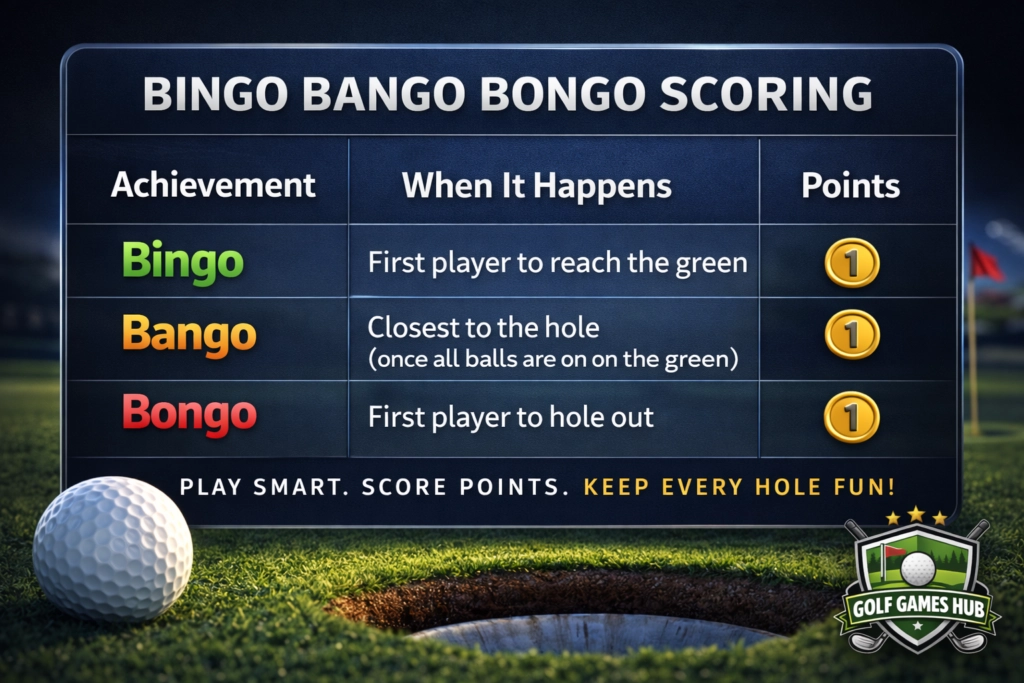
Bingo – 1 point for the first player to reach the green
Bango – 1 point for closest to the pin once all balls are on the green
Bongo – 1 point for the first player to hole out
The player with the most total points after all 18 holes wins the game.
This scoring structure means that players can earn points even if they do not win the hole, keeping everyone involved from the tee box all the way to the final putt.
The sections below explain all the rules and how to keep score when playing Bingo Bango Bongo.

The Key Rules of the Bingo Bango Bongo Golf Game
Bingo Bango Bongo is played using the standard Rules of Golf (counting strokes and penalties) while awarding points for specific achievements during each hole.
Each player plays their own ball for the entire hole, and points are distributed according to the following rules.
Setting Up the Game of Bingo Bango Bongo
Before beginning play, the group must establish the following:
- Number of Players
- Bingo Bango Bongo is playable with two to four players.
- Each player competes individually for points.
- Point Value
- Each of the three achievements on a hole—Bingo, Bango, and Bongo—earns one point.
- Some groups choose to assign monetary value to each point before the round begins.
- Play Order
- Players must play in order of who is farthest from the hole, consistent with standard Rules of Golf and golf etiquette.
- Playing out of turn removes the opportunity to earn certain points and disrupts the structure of the game.
- Ball Play
- Each player plays their own ball from tee to hole.
- Penalty strokes count toward a player’s score but do not directly affect point eligibility.
Once the hole begins, points are awarded for the three achievements described below.
Bingo Bango Bongo Scoring Explained
Each hole offers three separate points that players can earn during different stages of play.
Bingo
The Bingo point goes to the player who first reaches the green.
- The player must be the first to have their ball come to rest on the putting surface.
- The ball must remain on the green to qualify.
- If a player’s ball rolls off the green after landing, it does not count as reaching the green.
Bango
The Bango point goes to the player whose ball is closest to the hole once all players have reached the green.
Procedure:
- Wait until every player’s ball lies on the putting surface.
- Determine which ball is closest to the hole.
- Award the Bango point to that player.
Note that it is possible to tie on Bango if two balls are closest to the hole and equal distance from the cup. In this situation, you can either split the point or carry it to the next hole.
Bongo
The Bongo point goes to the player who holes out first.
Because play order must always follow the rule of the player farthest from the hole hitting first, the player who holes out first often does so because they successfully holed a longer putt.
No gimmies!
Each hole therefore awards a maximum of three points.
Because points are awarded for achievements, irregardless of skill-level, handicaps are not utilized in this points-based game.
How to Determine Winner in Bingo Bango Bongo
Points accumulate throughout the round as players earn Bingo, Bango, and Bongo achievements.
At the end of the round:
- Add the total points earned by each player.
- The player with the highest total points wins the game.
If players assign monetary value to points, winnings are typically calculated by multiplying the point difference between players by the agreed value.
Other Considerations for Bingo Bango Bongo
Bingo Bango Bongo works particularly well for mixed-skill groups because it rewards different aspects of the game. Players who struggle with distance off the tee can still earn points through accurate approach shots or strong putting.
Some groups also introduce variations such as awarding bonus points for birdies or doubling points on par-3 holes.
Our full Official Guide on Bingo Bango Bongo explains all the variations, helpful strategies, and scoring nuances in greater detail – check it out.

Other Fun Golf Game Formats to Consider
If you are more of a traditionalist, check out our Traditional Golf Games Collection. If you are looking for additional games with a little more fun and social activity, you’ll find more great options in our Fun & Social Golf Games Collection.
Below are a few of our hand-picked favorites for your consideration.
Wolf is a rotating four-player game where each hole gives one golfer the power to decide how the hole will be played. The designated Wolf can choose a partner after seeing tee shots or elect to play the hole alone for higher stakes. That decision-making element introduces a constant layer of strategy, timing, and risk management throughout the round. Because alliances shift from hole to hole and the rewards change based on the Wolf’s choice, the game stays unpredictable and competitive until the very end.
Chapman is a strategic two-versus-two team format that forces both partners to contribute on every hole. Each player hits a tee shot, partners then switch balls for the second shot, and the team chooses the better result before finishing the hole in alternate-shot format. That sequence creates constant decision-making and pressure, since both players must execute key shots at different stages of the hole. The format rewards solid ball striking, thoughtful strategy, and strong teamwork, making Chapman one of the most balanced and competitive partner games in golf.
Vegas is one of the most action-packed betting formats in golf because of the way scores are calculated. Instead of adding scores together, teammates combine their numbers to form a two-digit score—for example, a 4 and a 5 become 45. The opposing team does the same, and the difference between those numbers determines the payout for the hole. Because scores compound quickly, even a single mistake can create a massive swing in the match. That volatility keeps both teams fully engaged from the opening tee shot to the final green.



Leave a Reply